Hickeys: What They Are, How Long They Last, and What Actually Helps
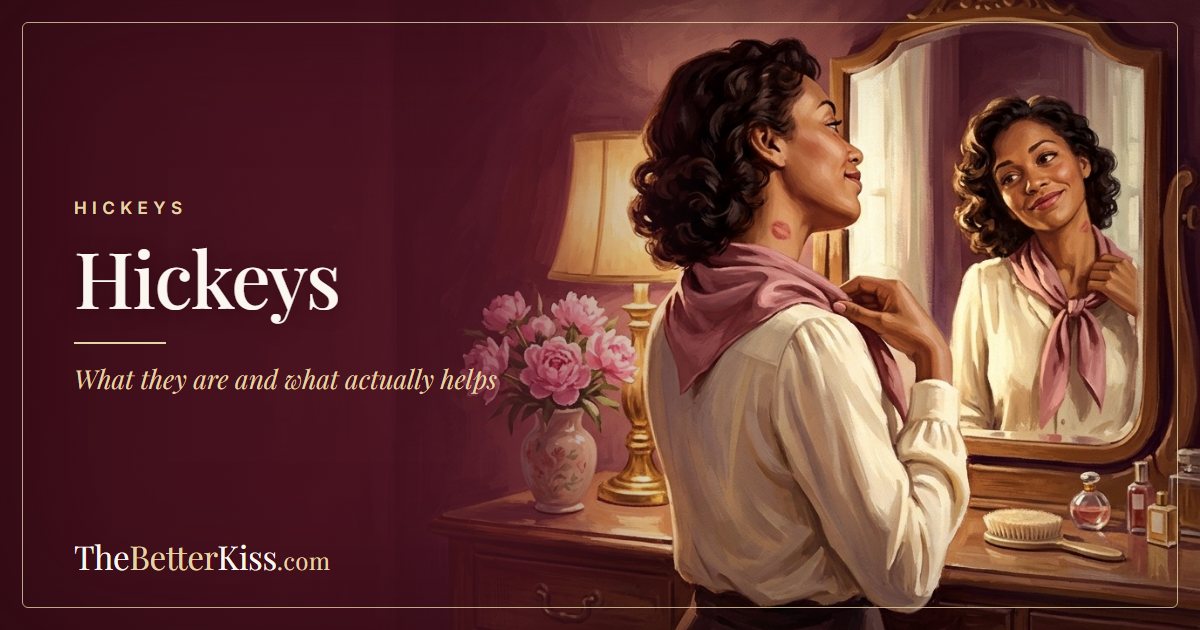
A hickey is the only kiss that leaves paperwork. It's also one of the most searched topics in all of kissing, mostly by people looking at a mirror with a deadline. So here is the honest version: what it is, how long you've got it for, what helps, what doesn't, and the one rule that comes before all of it.
On this page
What is a hickey?
A hickey — a love bite, in British English — is a bruise. When someone sucks on or bites the skin, the pressure breaks small blood vessels just under the surface, and the blood that leaks out is the dark red or purple mark you see. That's all it is. It isn't a rash, a burn or a mystery, and it behaves the way other bruises do. Dermatologists describe it as a shallow bruise, which is why it usually clears faster than the kind you get from walking into a table.
They appear most often on the neck because the skin there is thin and because the neck is where that kind of kissing tends to happen. They can be made anywhere the skin is soft: the shoulder, the collarbone, the chest, the inner arm.
What does a hickey mean?
From the person giving it, usually one of three things: they got carried away, they like the idea of leaving a sign, or they didn't realise how little pressure it takes. From the outside world's point of view it means only one thing, which is that everyone now knows what you were doing on Saturday. That gap, between a private moment and a public announcement, is the whole problem with hickeys and the reason for the rule below.
The rule: ask first
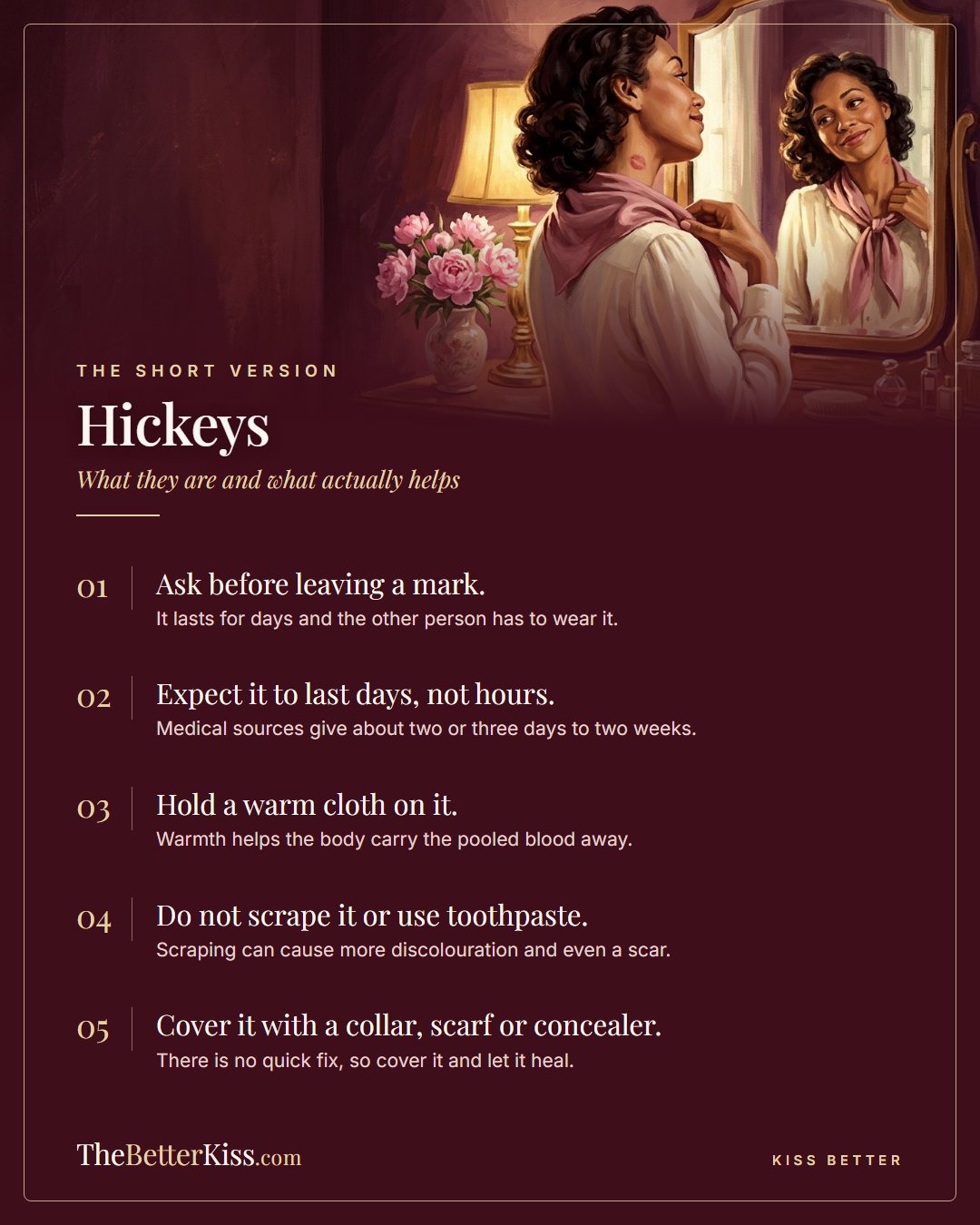
A hickey lasts for days and the other person is the one who has to wear it to work, to dinner with their mother, to the interview. That makes it a two-person decision. “Can I leave a mark?” takes one second, and “not where anyone can see” is a perfectly good answer. Leaving one without asking isn't passion. It's a decision you made about someone else's week.
The same goes in reverse: if you don't want one, say so early. “No marks” is a complete sentence.
How long do hickeys last?
Medical sources give a range of about two or three days to two weeks, depending on how deep the bruise is and how quickly you heal. It changes colour on the way out, roughly like this:
- Day one: red.
- Days one to two: darker — bluish-purple, sometimes nearly black.
- Days five to ten: green or yellow.
- Days ten to fourteen: yellowish-brown, then gone.
The colour change is a good sign. It means your body is clearing the blood. On darker skin the mark tends to look purple, dark brown or black throughout, and the stages are harder to see.
How to get rid of a hickey
The honest answer: there is no quick fix. Every medical source says the same thing in slightly different words. You can't remove a hickey; you can help it along a little and wait. What sensible care looks like:
Warmth. This is the one thing doctors agree on. A cloth soaked in warm water, held on the mark, up to four times a day. Warmth opens the blood vessels and helps the body carry the pooled blood away.
Cold, early, maybe. Here the advice splits. Some sources recommend a cold compress for ten to fifteen minutes at a time over the first day or two, particularly if the area is swollen. At least one dermatologist says cold is only worth it in the first few minutes and you should otherwise go straight to warmth. If you use ice, wrap it in a cloth. Never put it straight on the skin.
Creams, possibly. Arnica or vitamin K cream applied to the skin may help a bruise fade slightly sooner. The evidence is modest, and arnica isn't advised if you take blood-thinning medicine.
Time. This is the one that works. The best case for everything above is a day or two saved.
What doesn't work
Scraping it. The coin, the toothbrush, the fork, the lipstick cap twisted into the skin. These are the popular ones and they are the ones to avoid. Scraping or irritating a bruise can cause scratches, bleeding, more discolouration and even a scar, so you can end up with a bigger mark that lasts longer.
Toothpaste. Doctors specifically advise against it. It irritates skin and does nothing for a bruise.
The cold spoon. Not harmful, but not magic either. A chilled spoon is just a small cold compress.
Kitchen-cupboard cures. Banana peel, aloe and the rest turn up on plenty of lists. None has good evidence behind it. They won't hurt you, and they won't have it gone by Monday.
Pressing hard. Gentle rubbing is sometimes suggested, but too much pressure can make a bruise worse.
How to hide a hickey
Clothing. A collar, a roll-neck, a scarf, or hair worn down. Dull, reliable, undefeated.
Make-up. Choose the corrector by the colour of the mark: a green tone hides redness, a yellow tone covers purple. Then a concealer that matches your skin, patted on, not rubbed, with a little powder so it stays put.
A plaster. It works, though it tends to invite the question you were hoping to avoid.
Are hickeys dangerous?
For nearly everyone, no. It's a small bruise and it heals by itself. Three things are worth knowing.
The neck artery. Two cases of stroke after a hickey have been published in medical journals. The best known is from New Zealand, in which a woman had a minor stroke after a hickey over the large artery in her neck; doctors found a clot there, treated her, and she recovered. The second, reported in a Danish journal, was a woman in Greenland who was left with some lasting weakness. Both had other health problems that raise the risk of clots, and the full detail is here. Doctors stress that this takes a very unusual set of circumstances and may involve an artery that already had problems. The practical advice is simple: keep hickeys away from the side of the neck just below the jaw, and be gentle.
Broken skin. If a bite actually breaks the skin, it isn't a hickey any more. Treat it as a wound: clean it, and see a doctor if it looks infected.
Cold sores. The cold sore virus spreads by direct contact with the sore, so any kissing is best skipped while one is active.
When to see a doctor
If the mark hasn't gone after a couple of weeks. If it's very sore, or there's a lump over it. If you notice other bruises, especially ones you can't explain, because easy bruising can occasionally point to a blood or clotting problem. And if you take blood-thinning medicine, expect bruises to be larger and slower to clear. This article is general information, not medical advice.
How to give a hickey, if you've both agreed
Agree where first: somewhere clothing covers is the considerate choice, and the shoulder or the base of the neck is kinder than the side of the throat. Put your lips on the skin in a soft, slightly open oval and apply gentle suction for a few seconds, no teeth. Stop and look. It takes less than people expect, and the colour keeps developing for a while afterwards, so do less than you think you need. You can always add; you can't take it back.
How to avoid giving one by accident
Keep your lips soft and moving. A hickey takes suction held in one place, so the fix is simply not to stay still and not to suck. Kiss the neck lightly, move on, and go back to their mouth. Everything gentle about good kissing applies here twice over, and it matters most in the middle of a long make-out, which is when accidental ones happen.
More on hickeys
Each question above has its own guide: how to get rid of a hickey, how to hide one, how long a hickey lasts, the colour stages day by day, whether hickeys are dangerous, how to give one and what a hickey means.
Quick answers
Do hickeys hurt? Usually not much. They can be tender for a day or two, like any bruise.
Do they scar? Not normally. The scarring risk comes from scraping at them.
Can you get rid of one overnight? No. Cover it and let it heal.
Is a love bite the same thing? Yes. Same bruise, different side of the Atlantic.
I gave one without asking. Now what? Apologise without making excuses, offer the concealer, and ask next time.
One standing rule, here as everywhere on this site: none of this is a method for turning a no into a yes. A kiss that isn't wanted isn't a kiss worth having, and asking twice is pressure, not persistence.
If the nerves are the real problem
Knowing how isn't the same as being able to in the moment. The first module of our guided course is free: no card, no account, about ten minutes.
Start module one, free