How to Make Out: The Honest Guide

This guide is written for adults.
On this page
- What “making out” actually means
- Kissing, French kissing, making out: the difference
- Before you start
- How to start
- The middle: how to keep it good
- Getting comfortable
- What to do with your hands
- The seven usual mistakes
- Talking during it
- Reading how it's going
- How to end it
- With someone new
- With someone you've been with for years
- Questions people ask
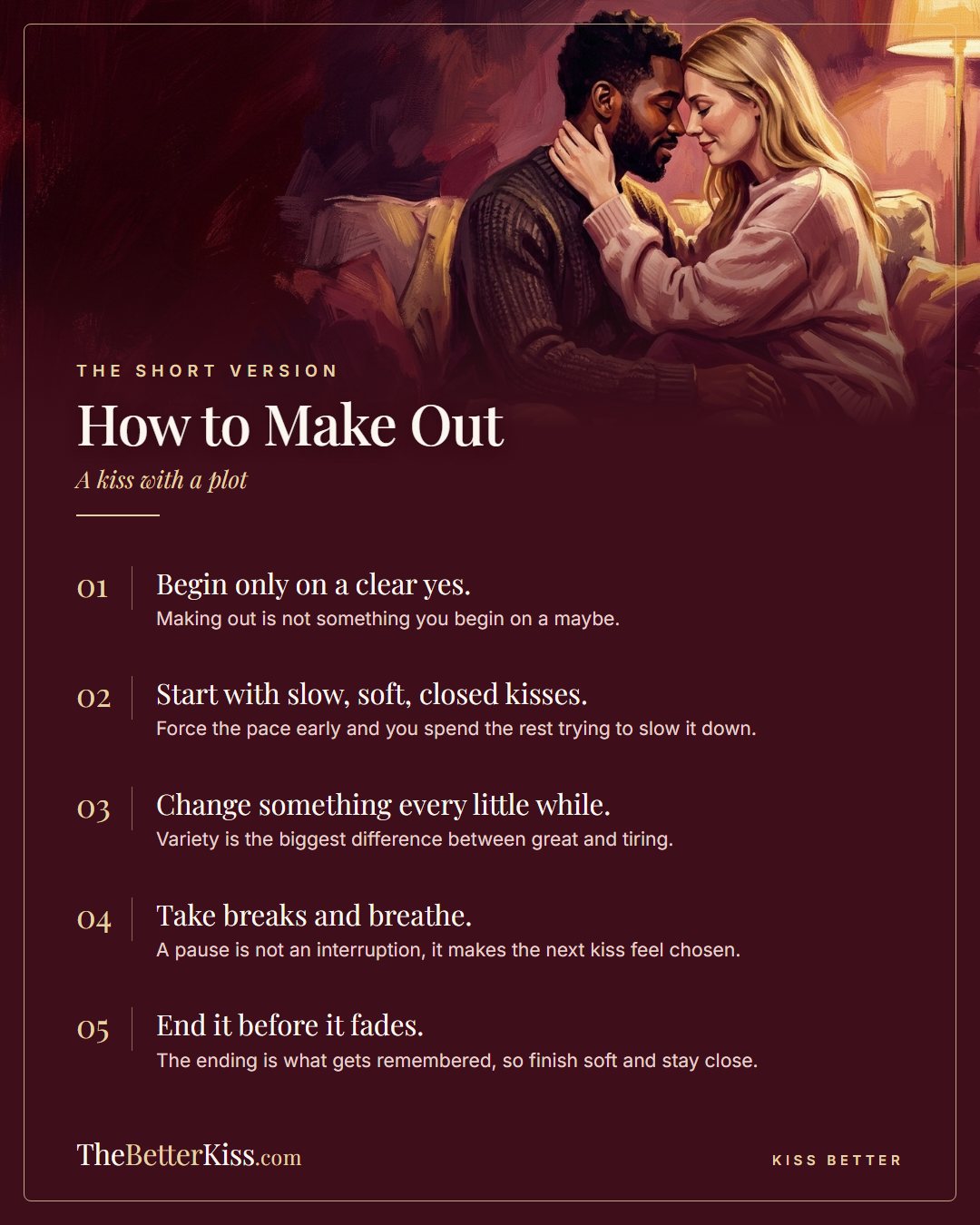
A kiss is a moment. Making out is a kiss with a plot: a beginning, a middle that goes somewhere, and an ending you both remember. People worry they don't know how, and almost all of that worry is about the middle. So here's the whole thing, in order.
What “making out” actually means
Extended kissing — minutes, not seconds — usually with some open-mouth kissing, hands involved, and bodies close. That's it. It doesn't have to lead anywhere. For a lot of couples it's the thing they miss most once it quietly disappears, precisely because it was never a means to anything else.
Kissing, French kissing, making out: the difference
A kiss is one event. A French kiss is a kind of kiss, with tongue. Making out is a session: many kisses of different kinds, strung together, with your hands and the rest of you involved. So you don't need a special technique for it. You need the ordinary skills of kissing well, plus two that only matter over several minutes: pacing and variety.
Before you start
Three small things. Somewhere you won't be interrupted or watched, because nobody relaxes with one eye on the door. Fresh breath and water nearby. And a clear yes: making out is not something you begin on a maybe. If you aren't sure, here's how to read the moment, and how to ask.
How to start
With an ordinary kiss, slower than you think. Closed-mouth, soft, a few of them, with small pauses between. You're not warming up for the real thing; this is the real thing, at its opening speed. Let it deepen when it wants to. If you force the pace in the first thirty seconds, you'll spend the rest of the time trying to slow it down.
The middle: how to keep it good
Vary it. The single biggest difference between a great make-out and a tiring one is variety. Change something every little while: pressure, pace, closed to open and back, lips to jaw to neck and back to lips.
Use tongue sparingly. A little, in phrases, then back to lips. The French-kiss guide covers this properly; the short version is that tongue is a seasoning.
Take breaks. Pull back, breathe, look at them, smile, say something. A pause isn't an interruption. It's what makes the next kiss feel chosen.
Match, then lead a little. Meet what they're doing, then change one small thing and see if they come with you. That back-and-forth is what people mean by chemistry.
Getting comfortable
Nobody mentions this, and it decides how long a make-out lasts. If one of you is twisted sideways on a sofa or craning upward, somebody's neck gives out in three minutes. Face each other. Get roughly level: sit, lean against something, or lie side by side. If there's a big height difference, the taller one sits down. Move when you need to. Shifting position isn't breaking the mood; it's what lets the mood continue.
And breathe through your nose. It sounds too obvious to say, and holding your breath is the main reason people come up gasping and call it passion.
What to do with your hands
Something, on purpose. Start with the safe, warm places: the side of their face, the back of their neck, their hair, their waist, the small of their back. Hold rather than roam. If you want to move a hand somewhere more intimate, go slowly enough that they could stop you, and notice whether they lean in or go still. Still means stop. Better yet, ask: “is this okay?” takes nothing away from the moment and adds a great deal to how safe they feel in it.
The seven usual mistakes
Starting at full intensity. There's nowhere to go from there. Begin low and build.
One kiss on repeat. Same pressure, same rhythm, for minutes. Change something.
Tongue the whole time. It's tiring and it stops being interesting. In and out, mostly out.
Too wet. Swallow now and then. Keep your lips soft, not slack.
Forgotten hands. Either dangling or clamped in one spot. Move them occasionally, slowly.
No pauses. A make-out with no breaks becomes an endurance sport.
Escalating on autopilot. Treating every minute as a step toward something else. Stay where it's good.
Talking during it
You're allowed to speak, and a few words make it better, not worse. “Come here.” “I like that.” “Slower.” Their name. A laugh when noses bump or someone's arm goes to sleep. Silence is fine too, but a make-out where neither of you could say anything has usually stopped being a conversation.
Reading how it's going
Good signs: they pull you closer, they match your pace, their hands are busy too, they come back in after a pause. Signs to slow down or stop: they go still, they turn their head, their hands come up between you, they stop kissing back. Don't push through a quiet no. Ease off, check in, and take the answer you get.
You're allowed opinions too. “Slower,” “softer,” “stay there” and “let's stop here” are all things good partners are glad to hear.
How to end it
Before it fades, not after. Slow the kisses down, finish with a soft closed one, and stay close for a moment. Say something warm. The ending is what gets remembered, and a make-out that ends with a smile and a kiss on the forehead is remembered very kindly.
With someone new
Keep the first one shorter than you'd like. Stay with kissing and gentle hands, check in once (“this okay?”), and end it while it's still good. You're finding out how the two of you kiss, and that takes more than one evening. A first make-out that stops a little early is how you get a second.
With someone you've been with for years
Long-term couples often stop making out altogether. Kissing shrinks to a peck or becomes a brief formality on the way to sex. Bringing it back is one of the simplest things you can do for a relationship: ten minutes on the sofa with no agenda, phones elsewhere. Research on couples found that how often they kiss tracks how satisfied they are with the relationship more closely than how often they have sex (Wlodarski & Dunbar, 2013). It will feel faintly silly for about a minute. Then it won't.
Questions people ask
How long should it last? As long as it's still interesting to both of you. Five minutes of varied kissing beats twenty minutes of the same kiss.
What if I've never done it? Then go slowly and say so if you like. “I'm a bit nervous” is disarming, and a careful beginner is a better experience than a careless expert. If the nerves are the main event, start here.
What about marks? Kiss the neck lightly and keep moving. A hickey is a bruise, and leaving one is something you ask about first.
Eyes open or closed? Closed, mostly. Open them in the pauses; that's what the pauses are for.
What if my lips get sore or dry? That's your cue for a break. Water, a bit of lip balm, back to softer kisses.
What about stubble? It can leave the other person's skin red and sore. Shave beforehand or keep your chin out of it.
What if I need to stop? Say so. “Let's take a break” or “that's enough for me tonight” needs no explanation, and the right reply is “of course.”
Does it have to lead to more? No. It's complete as it is, and treating it that way is usually what makes it good.
One standing rule, here as everywhere on this site: none of this is a method for turning a no into a yes. A kiss that isn't wanted isn't a kiss worth having, and asking twice is pressure, not persistence.
If the nerves are the real problem
Knowing how isn't the same as being able to in the moment. The first module of our guided course is free: no card, no account, about ten minutes.
Start module one, free