Your First Kiss: How to Actually Have It
Every first-kiss article gives you ten tips for the eight seconds of kissing and nothing for the two hours around it. (Already dating the person? The first kiss with someone you know is its own thing. Not sure you're ready at all? Start with the checklist.) Backwards. The kiss is the easy part; here's the rest. (Not sure you're ready? Here's an honest checklist.) (Never had one? Start with the truth about being “behind”.)
On this page
Where they actually happen
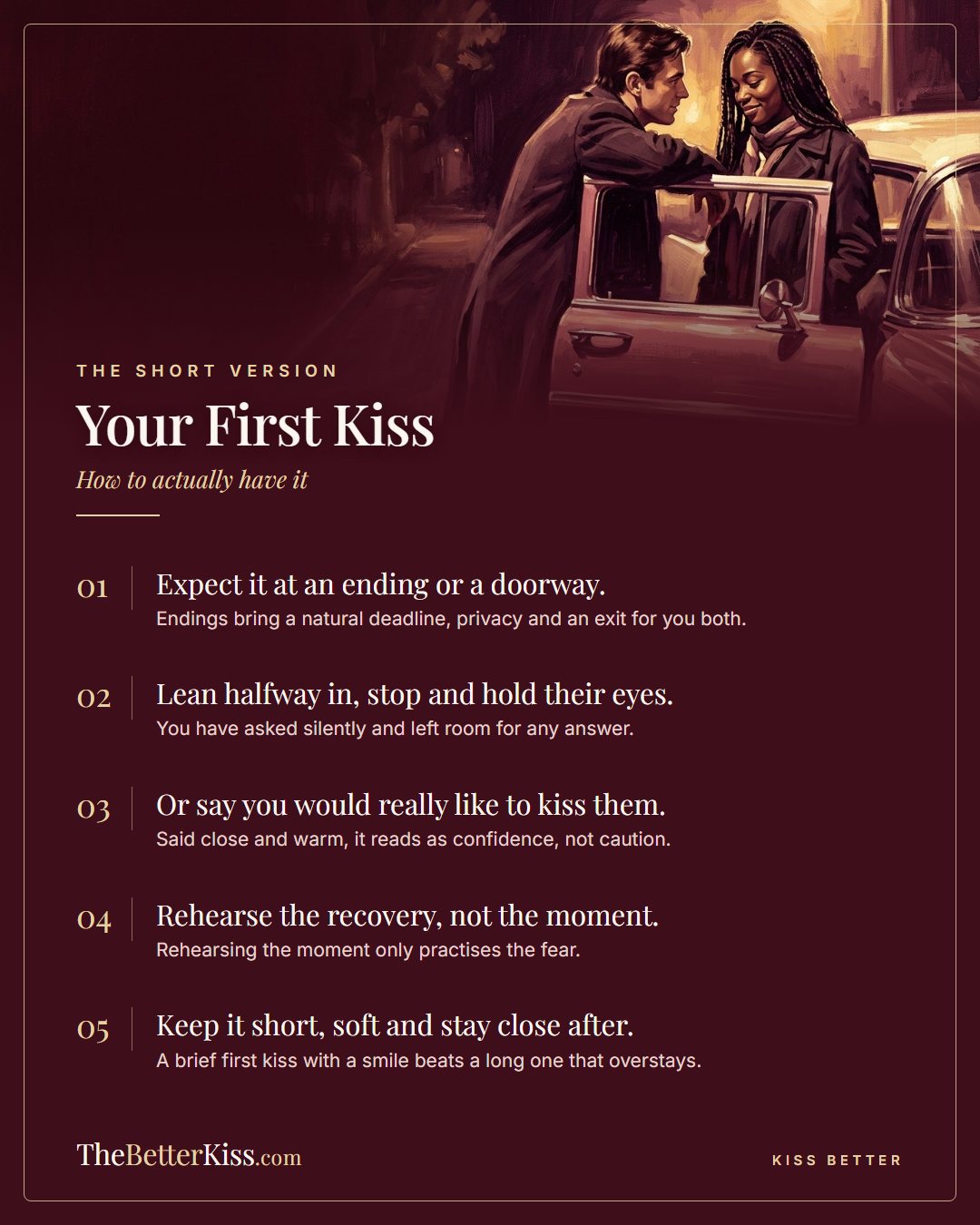
Endings and thresholds: the walk to the car, the doorway, the pause before goodbye. Why? Because endings concentrate the evening — there's a natural deadline, a natural privacy, and a built-in exit for both of you either way. If you're waiting for a perfect mid-date lightning bolt, you're waiting for something rarer than the doorway, which arrives every single time.
Read, then ask with your body
The signals worth trusting come in clusters: they're facing you fully, they closed distance and stayed, eye contact keeps returning, the conversation goes quiet without going awkward. Then the move that changes everything — the half-distance test: lean about halfway in, stop, hold their eyes. You've asked, silently, with room for any answer. They close the gap or stay warm and near — go, slowly. They pull back or laugh it off — smile, carry on talking, and nothing needs recovering from. Full guide to reading it.
Or use words — the two-second version
“I'd really like to kiss you.” Close, quiet, warm, then stop talking. Said like something you want rather than a permission slip, it has roughly a 100% comprehension rate and reads as confidence, not caution.
The hour before: what to actually do with the nerves
Don't rehearse the moment — you'll only practise the fear, and each run-through makes the imagined disaster more vivid. Do two things instead. First, name the physiology: the racing heart and the dry mouth are adrenaline, and adrenaline is chemically identical whether you call it terror or excitement. Say "this is excitement" once, out loud, and you've corrected a label rather than faked a feeling. Second, rehearse the recovery, not the triumph — picture it going slightly wrong, you saying something ordinary, both of you laughing, the evening continuing. That's the realistic good outcome and the one worth having available.
And drop the crutches. The two drinks, the memorised line, the plan to only go for it if the lighting is right. Each one teaches you that you only managed because you had the trick.
The kiss itself: three lines
Soft jaw — tension starts there. Smaller and slower than you think — you can build, you can't un-lunge. Brief is beautiful — a short first kiss with a smile after beats a long one that overstays.
The five most common first-kiss worries, answered
"Where do the noses go?" Both of you tilt slightly and they sort themselves out. This is the most over-worried detail in all of kissing, and it has never once ended an evening.
"What about my breath?" Brush your teeth like a normal adult, then stop thinking about it. Carrying mints is fine; needing them before you can proceed is a crutch.
"What if they can tell I'm inexperienced?" They probably can't — nerves are far less visible from outside than they feel inside. And if it comes up, said lightly it's endearing; said as a confession it hands them a problem to manage. The tone is entirely your choice.
"How long should it be?" Three or four seconds, ended while you both want more. Brief isn't timid — brief assumes there'll be another one.
"What if I'm bad at it?" Almost nobody's first kiss was good. The universal experience is clumsy, brief and slightly wet, followed by not knowing what to say. The people who look effortless now had exactly that kiss; they just had it earlier and stopped mentioning it.
Afterwards
Stay close a beat. Say something warm and ordinary — “I've been wanting to do that” works forever. If it was awkward: laugh, together; shared awkwardness bonds people and second kisses are almost always better. And if the nerves before the moment are the real wall — the racing heart, the mind that watches itself — that's not a technique problem, it's this one, and it has a real fix.
If the nerves are the real problem
Knowing how isn't the same as being able to in the moment. The first module of our guided course is free: no card, no account, about ten minutes.
Start module one, free