Never Been Kissed? Here's the Truth About Being 'Behind'
If you found this at 1am, wondering whether you're the only adult on earth who hasn't done this yet: you aren't. Not remotely. You're a member of a large, invisible club whose members never introduce themselves — which is the only reason it feels small.
On this page
The timeline doesn't exist
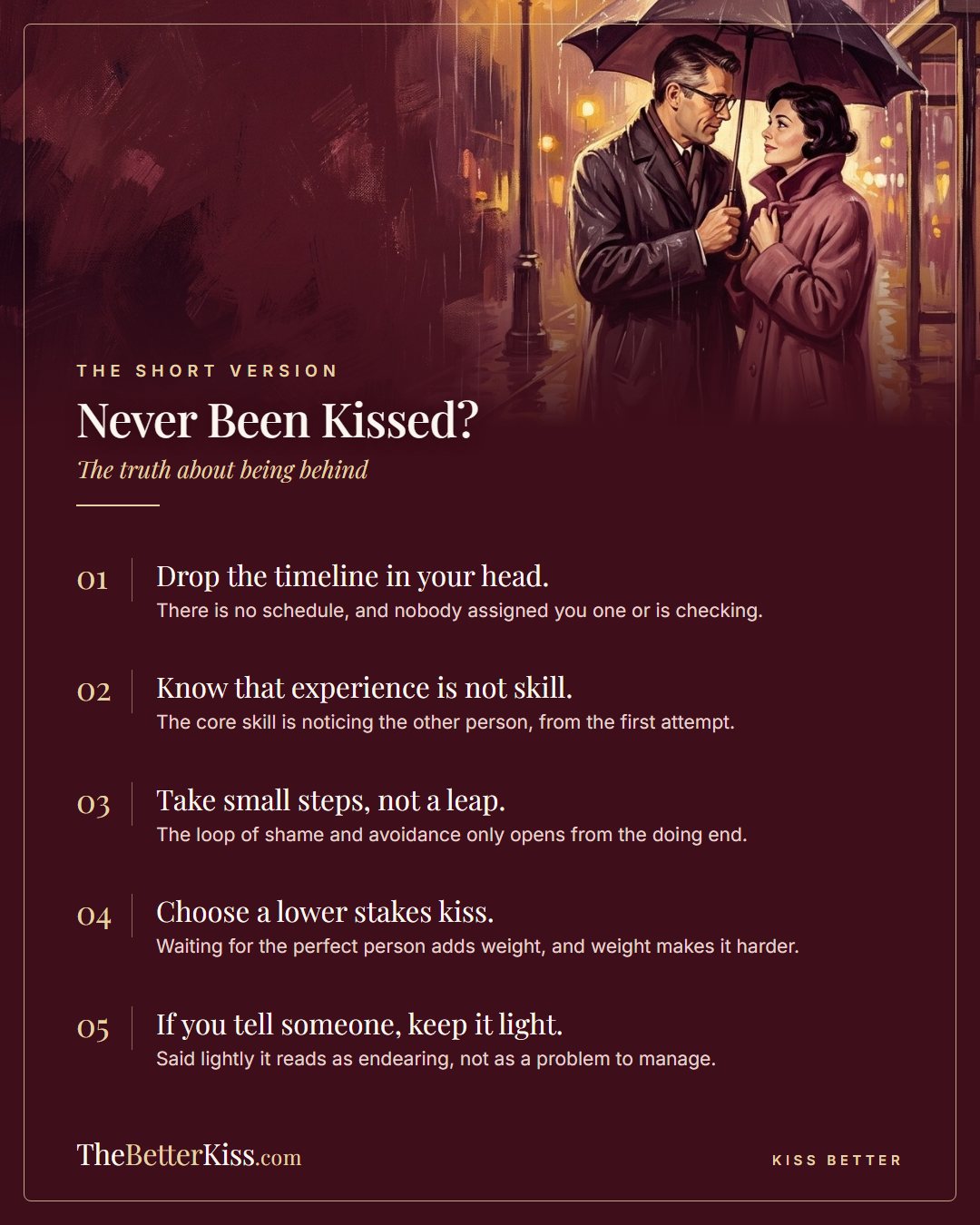
You believe there's a schedule you've fallen off. There isn't one. First kisses happen at fourteen and at forty-four, and adults arrive at this point by every route there is: strict upbringings, illness, caring for someone, long stretches of anxiety, geography, religious timing, or plain bad luck with chance. None of these is a defect. All of them are common. The number in your head — the age you “should” have done this by — was assembled from films and overheard conversations. Nobody assigned it to you, and nobody is checking.
What everyone's first kiss was actually like
Clumsy, brief, oddly wet, and immediately followed by not knowing what to say. That's the universal experience, and the people who seem effortless now had exactly that kiss — they just had it earlier and stopped mentioning it. Meanwhile, experience isn't skill: someone who has kissed forty people inattentively is worse at this than someone who kisses one person with real attention. The core skill is noticing the other person, and it's available to you from the very first attempt.
The loop, and where it opens
Here's the mechanism keeping this stuck: shame makes you avoid the situations; avoidance means you never gather evidence it would have been fine; no evidence means the fear keeps its full size. That loop runs indefinitely on its own — and it opens from the doing end, never the reading end. Small steps, survived, repeated. Not a leap. (Here's the full mechanism, and here's where to start.)
How common is this, actually?
More common than the silence suggests, and the silence is the whole problem. Nobody announces it, so everyone who hasn't kissed anyone concludes they're the only one — which is a statistical impossibility repeated across millions of people simultaneously. Late starts cluster around identifiable causes: illness or disability during the usual years, caring responsibilities, strict or religious upbringings, anxiety disorders, moving countries, years spent in an environment with no realistic opportunity. None of those describes a defective person. They describe circumstances.
What actually changes afterwards
Less than you expect, and that's the good news. People who've built a decade of meaning around this milestone often describe the aftermath as an anticlimax — and then, a day later, as an enormous relief. The thing you've carried becomes an ordinary event you've now done. It doesn't transform you. It just stops being a wall.
The trap to avoid
Waiting for the perfect person, so that the first kiss is meaningful enough to justify the wait. It's the most understandable instinct here and it makes everything harder: every year of waiting adds weight to the moment, and weight is exactly what makes it difficult to act. The way out is a lower-stakes kiss, not a higher-stakes one. (And if you're wondering whether you're actually ready, here's the honest checklist.) That feels like a demotion of something sacred. It's actually the only exit.
On telling people
You're not obliged to tell anyone. If you choose to, the entire outcome lives in the delivery: “just so you know, I haven't done this much” — light, brief, moved past — reads as endearing. The same fact delivered as a confession hands the other person a problem to manage. The tone is yours to pick, and light wins. When you want the practical plan for the moment itself, it's written out step by step.
If the nerves are the real problem
Knowing how isn't the same as being able to in the moment. The first module of our guided course is free: no card, no account, about ten minutes.
Start module one, free