How to Tell If Someone Wants to Kiss You
Let's start with the honest bit nobody else will print: you will never be 100% certain. Nobody is. People who look confident are operating at about 80% and have made peace with the rest. Anyone selling certainty from body language alone is selling something that doesn't exist. What follows gets you to 80 — and if this whole question makes your chest tight, the nerves themselves have a mechanism worth understanding first — and then gives you a way to close the gap that risks almost nothing.
On this page
Signals that actually mean something
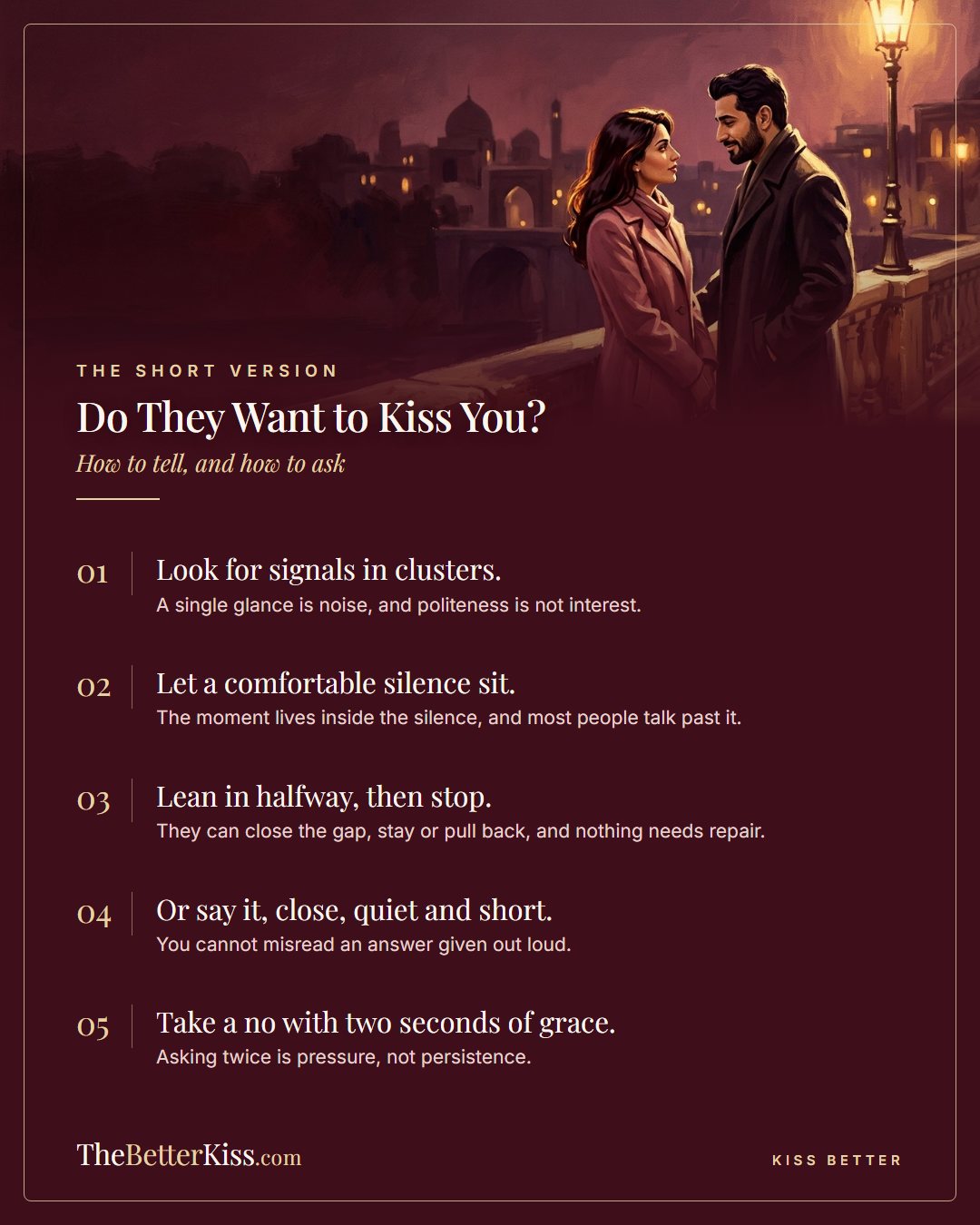
They're facing you — torso and feet, not just their head. Orientation is much harder to fake than an expression. They closed the distance between you and stayed there; chosen proximity is one of the strongest signals available. Eye contact that holds, breaks, and comes back — the coming back is what counts. Touch they initiated, especially if it lingered. And the big one: the conversation goes quiet without going awkward. Most people fill that silence with nervous chatter and talk straight past the moment. The moment lives inside the silence.
What isn't a signal
Politeness isn't interest — warmth and laughing at your jokes is most people being nice. A single glance is noise; signals matter in clusters. “They haven't moved away” is not a yes — freezing is a real response to discomfort, and it looks like stillness. And if either of you is meaningfully drunk, that's a night for going home; nothing readable survives that much blur. Finally, the rule that saves you from yourself: if you had to work hard to interpret it, it probably isn't there. Real signals are noticeable. If you're building a case, you're building a case.
Why the silence is the signal
Of everything above, the quiet is the one people miss — because it's the only signal that requires you to do nothing. A conversation that goes quiet and stays comfortable is a conversation that has run out of other things to be. Most people panic there and fill it: a joke, a topic change, a glance at their phone. And the moment passes, correctly interpreted by nobody.
Try this instead: when it goes quiet, let it. Five seconds. Hold eye contact, look faintly amused, say nothing. If they hold it too, that's your answer — and you got it without risking a thing.
The half-distance test
Here's the technique. Move about halfway into the space between you. Then stop. Hold the eye contact. Do nothing else.
You've just asked a question with your body, quietly, and given them room to answer. There are three answers. They close the rest of the distance — a yes, and they chose it, which beats you guessing. They stay, hold your eyes, maybe glance at your mouth — a yes; move slowly. Or they pull back, laugh, change the subject — a no, or a not yet. Smile and carry on talking.
That third answer is the entire point. You found out without putting either of you somewhere that needs recovering from.
Or just ask — and how to do it well
Most people believe asking ruins the moment. It's the most common objection in this whole subject and it's mostly wrong — but how you ask matters enormously, and nobody teaches it, which is why people try it once, do it awkwardly, and conclude it doesn't work.
Asking badly sounds like: "Would it be okay if I kissed you?" — permission-slip energy, delivered from four feet away with your hands in your pockets. Or the preamble version — "can I ask you something, um, so I was wondering if maybe…" — where the run-up does the damage, not the question.
Asking well is close, quiet, short, and warm. "I'd really like to kiss you." It's a statement, not a request; say it and then stop talking. Or, mid-moment, quietly: "is this okay?" Two seconds, and it breaks nothing. If your central fear is misreading the situation, words dissolve that fear entirely — you cannot misread an answer given out loud.
What it isn't: talking someone round
One line worth drawing clearly. Everything on this page is about finding out whether a kiss is wanted. None of it is about producing a yes from a no. If you ask and the answer is no, the answer is no — asking twice isn't persistence, it's pressure, and it converts an ordinary moment into one they'll remember badly. The skill being taught here is reading and asking. That's the whole skill.
If it's a no
Two seconds of grace: smile, lean back naturally, say something ordinary — “sorry, I got ahead of myself” — and continue the conversation. No repeat apologies, no explaining, no going quiet and wounded. A misread handled well is not a humiliation; it's an ordinary thing that happens to everyone who has ever dated. It only feels catastrophic in advance because you've been rehearsing the version where you fall apart. You're allowed to not have that version. Next: the full plan for a first kiss, from the doorway to the moment after.
If the nerves are the real problem
Knowing how isn't the same as being able to in the moment. The first module of our guided course is free: no card, no account, about ten minutes.
Start module one, free