How to Kiss: The Honest Guide
Most guides to kissing are written as if it were choreography — a routine to memorise, graded by a judge. That framing is exactly backwards, and it's why the advice never helps. (Want the quick version — genuinely useful tips, minus the myths? Start here.) A kiss is not a performance. It's a conversation with turns. Once you understand that, everything else is detail. (If what stands in your way is nerves rather than knowledge, start with the confidence hub instead — this guide will still be here.)
On this page
- Start an inch below your ear
- Softer and slower than you think
- The conversation: match, then vary
- Hands: deliberate or absent
- Where the tongue comes in
- Breathing, teeth, and the other unglamorous mechanics
- On breath and preparation
- Duration, and the myth of the long kiss
- The pause is a move
- What happens afterwards matters more than the kiss
- The skill underneath all of it
Start an inch below your ear
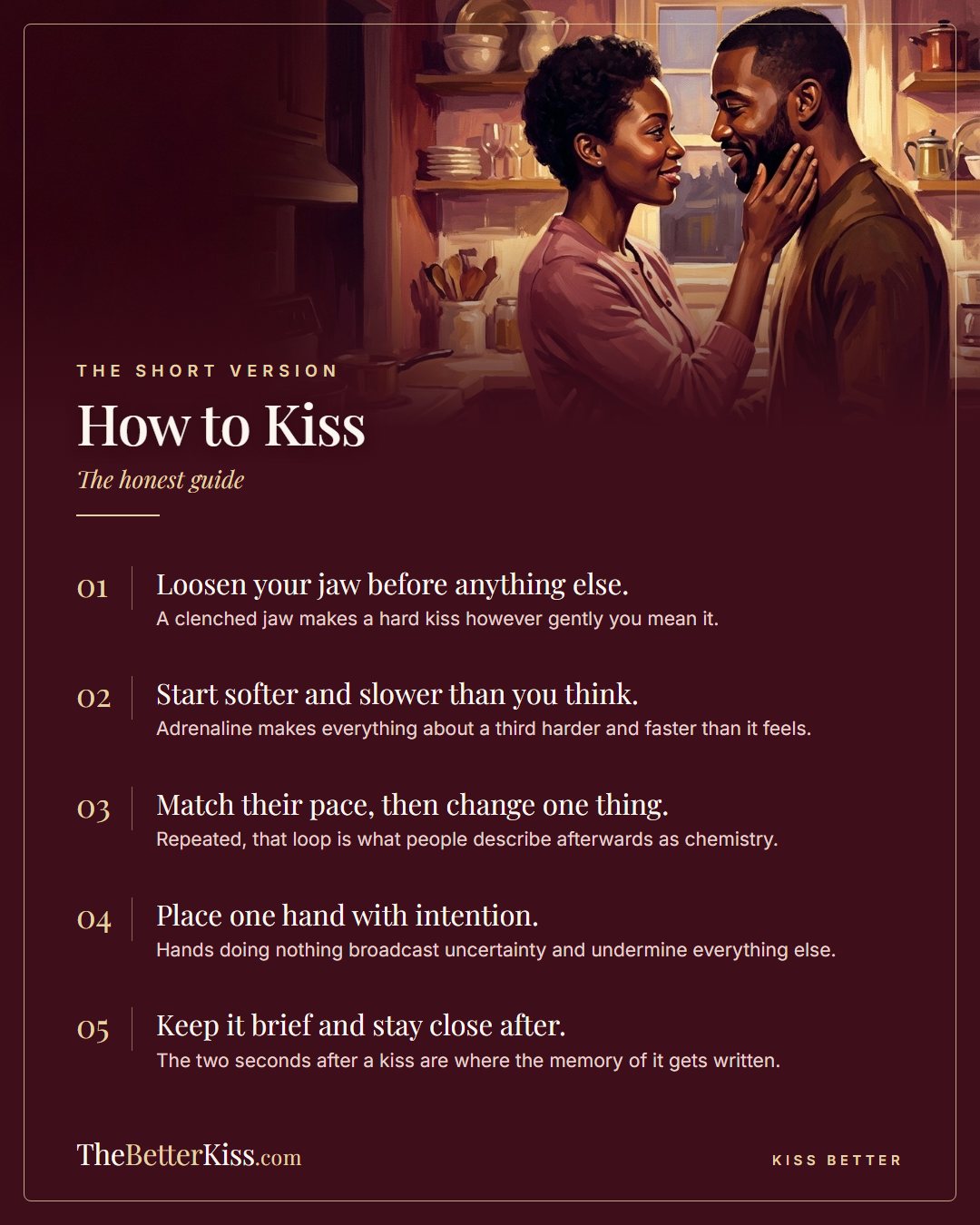
Every good kiss begins with the jaw. Tension starts there and travels straight to the lips — a clenched jaw makes a hard kiss no matter how gently you mean it. So before anything else: teeth apart, tongue resting, jaw loose. Feel your lips soften on their own. That second mouth is the one that kisses well.
Softer and slower than you think
The most common technical fault isn't sloppiness — it's firmness. Under adrenaline, everything you do will be about a third harder and faster than it feels from inside. So start smaller than you think. You can always build; you can't un-lunge. Tilt slightly — both of you will, and noses sort themselves out. This is the most over-worried detail in all of kissing. For the deeper version of this kiss, see how to French kiss.
The conversation: match, then vary
Here is the core loop of every kiss anyone has ever called great. Match what they're doing — their pace, their pressure — long enough to be in the same conversation. Then change one thing: slightly slower, slightly softer, a pause. Match, vary. Match, vary. Repeated, that loop is what people describe afterwards as chemistry.
Sameness is the only real mistake. A kiss that feels too long is almost never too long — it's too same. One change resets the clock completely.
Hands: deliberate or absent
Hands doing nothing undermine everything else — they broadcast uncertainty. One hand placed with intention — the jaw, the side of the neck, the waist — beats two hands hovering. Placed, not landed. The difference is the entire skill.
Where the tongue comes in
Only when invited, and less than you think. A French kiss is an escalation, not an opening: you notice the kiss deepening on its own — lips parting, breath changing — and the tip of your tongue meets theirs briefly. Then you wait. If they answer in kind, you're both there. If they don't, you're still in a lovely ordinary kiss and nothing went wrong. Tongue is a seasoning, not a main course; the full guide is here.
Breathing, teeth, and the other unglamorous mechanics
Breathe through your nose, unhurried. Running out of air makes people rush, and rushing reads as nerves rather than passion. Teeth are scaffolding, not participants — if you clash, pull back a centimetre, smile, resume; shared amusement resets everything. And swallow before, not during. None of this is romantic to read and all of it is the difference between a kiss someone enjoys and one they endure politely.
On breath and preparation
Mind it, then stop thinking about it. Brush your teeth like a normal adult; carry mints if you like. But notice the line: carrying mints is fine, needing them before you can proceed is a crutch — and crutches quietly teach you that you're only acceptable with the trick. The same logic applies to needing two drinks, or low lighting, or a rehearsed line. Each one keeps the fear alive by preventing you from learning you'd have been fine.
Duration, and the myth of the long kiss
A first kiss of three or four seconds, ended while both of you still want more, beats a thirty-second kiss that outstays its moment. Brief is not timid — brief is confident, because it assumes there will be another. And when there is another, that second kiss is almost always better than the first: most of what makes a first kiss awkward is simply not knowing the other person's rhythm yet. Now you do.
The pause is a move
Breaking for one breath — staying close, forehead almost touching — is the most underused technique there is. It creates a beat of wanting, and it lets both of you feel you're choosing to continue rather than merely not stopping. Great kisses have punctuation.
What happens afterwards matters more than the kiss
Almost nobody remembers whether a first kiss was technically good. What people remember for years is whether the other person was kind about it — kind about the nerves, the awkwardness, the timing. That's entirely within your control, requires no experience whatsoever, and is the only part that ever really mattered.
Practically: stay close for a beat rather than pulling away to check their face for a verdict. Exhale. Let a smile arrive. Say something warm and ordinary — "I've been wanting to do that" has never once failed. The two seconds after a kiss are where the memory of it gets written.
The skill underneath all of it
Everything above is a variation on one instruction: put your attention on them, not on you. Notice what they do back. Notice when they slow. Meet them. The best kissers aren't the ones with the most moves — they're the best listeners. (More on the one skill that makes someone good at this.) And if what stands between you and any of this is nerves rather than knowledge, that's a different problem with a different fix — and it's the one we take most seriously of all — read what's actually happening with first-kiss nerves. And when you want the wider vocabulary, every kiss has its own sentence.
If the nerves are the real problem
Knowing how isn't the same as being able to in the moment. The first module of our guided course is free: no card, no account, about ten minutes.
Start module one, free