Kissing With Confidence: Where to Start
This page is the front door for one kind of reader: the one for whom the obstacle was never information. You've read the technique guides. You know about the jaw and the tilt. And the moment still makes your stomach drop — because your problem is the fear, and fear doesn't read.
On this page
The mechanism, in one paragraph
Kiss anxiety runs on a documented engine: spectatoring — watching and grading yourself from the ceiling during the moment (the monitoring causes the stiffness it fears); a body whose excitement chemistry is identical to its fear chemistry, misread as alarm; and a shame loop where avoidance prevents you ever collecting the evidence that you'd have been fine. Understanding it helps. Understanding it is also not enough — fear shrinks through small, survivable, repeated doing.
The three thieves
Anxiety takes the moment from you in three separate places, and knowing which is yours tells you where to put the work.
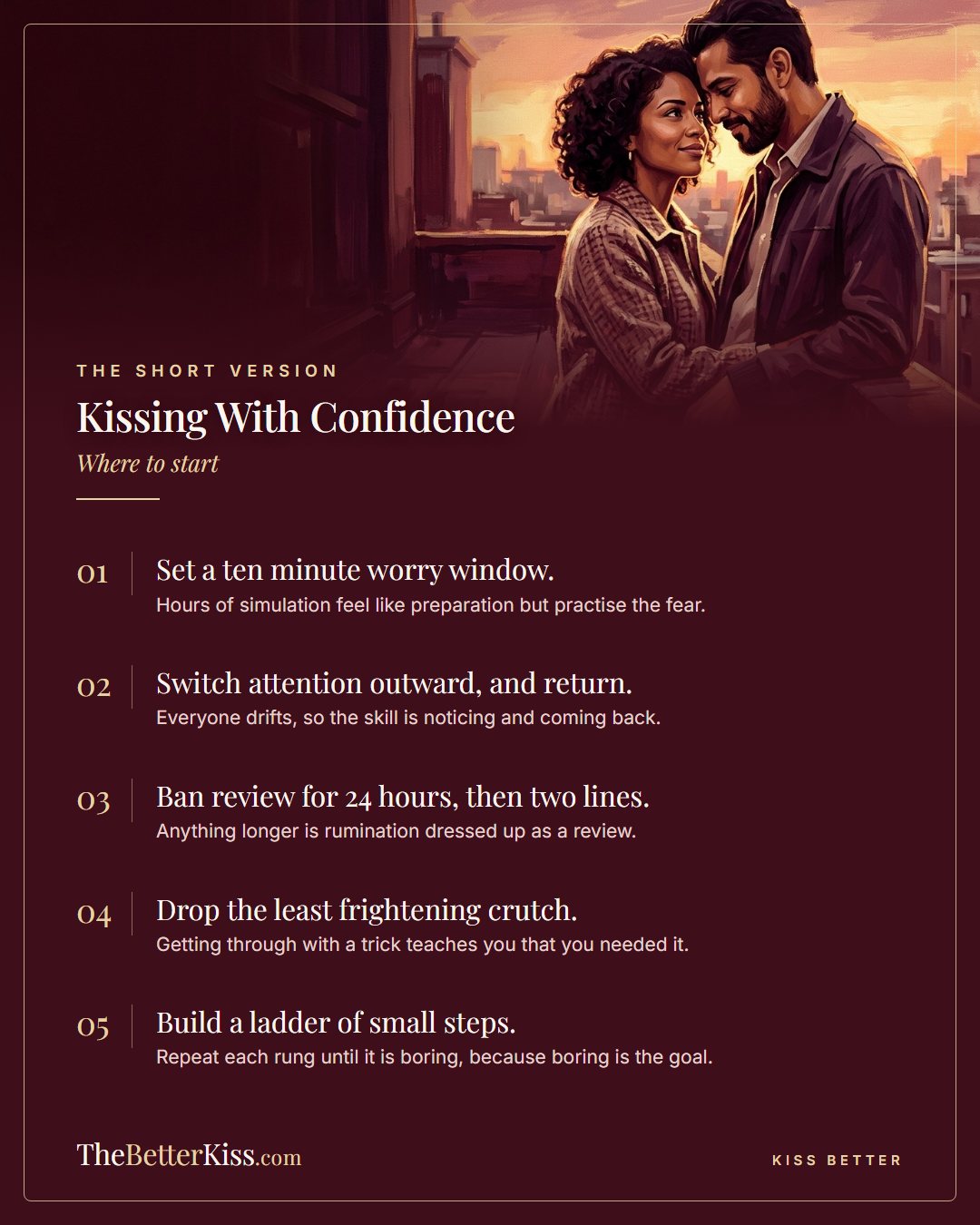
Rehearsing beforehand. Hours of simulations that feel like preparation and function as practice of the fear. The fix is a worry window — ten deliberate minutes, written down, then closed — plus rehearsing the recovery rather than the disaster. Not the perfect version: the one where it's slightly awkward, you both laugh, and you carry on. That's the realistic good outcome, and it's the one worth having available.
Watching yourself during. The spectator. The fix is the attention switch — outward, onto them — and, crucially, the return. You will drift mid-kiss. Everyone does. The skill isn't never drifting; it's noticing and coming back to something physical: temperature, pressure, their breathing.
Replaying afterwards. The 2am post-mortem, which converts a neutral evening into evidence against you. The fix is a 24-hour ban on review, then exactly two lines: one thing that went fine, one thing you'd do differently. Anything longer is rumination wearing a review's clothes.
The crutches to put down
Two drinks first. The rehearsed line. Low lighting. Waiting for them to initiate, always. Each one feels like help and each one quietly guarantees the fear stays, because getting through the moment with the trick teaches your mind that you couldn't have managed without it. Pick the least frightening one and drop it. It will feel worse in the moment — that discomfort is the learning happening.
Read these, in this order
1. First-Kiss Nerves: the actual mechanism — why every other article missed the point.
2. How to tell if someone wants to kiss you — the half-distance test, which removes most of the risk.
3. Am I a bad kisser? — for everyone whose fear is the verdict.
4. Never been kissed — the truth about being “behind.”
5. Then, only then, the technique pillar — because technique lands only once the spectator sits down.
What actually shrinks a fear
Not insight. Doing.
The method with the strongest evidence behind it for social anxiety is graded exposure: rather than throwing yourself at the terrifying thing, you build a ladder of smaller versions and climb it, repeating each rung until it's boring. Boring is the goal. Boring is what recovered looks like.
A ladder for this might start nowhere near a kiss: holding eye contact one beat longer with someone you find attractive, then smiling and looking away. A conversation with no goal. An ordinary touch on an arm to make a point. Saying the words out loud, alone, in an empty room. Letting a charged silence sit for five seconds. Then the half-distance test — where a "no" counts as completing the rung, and is arguably the more valuable outcome. Then a brief kiss. Then a kiss with your attention outward, which is what all of it was for.
The rule that makes it work: start at a step that's genuinely uncomfortable but doable — roughly a three or four out of ten on distress. A one teaches you nothing. An eight sends you backwards and makes the next attempt harder.
When reading stops being enough
It will — that's not a failure, it's how fear works. For that point we built Kiss Confidence: a guided course that treats the anxiety as the real subject, walks you through it step by step like a coach, responds to what you tell it, and ends with a ladder of small real-world steps sized to your own ratings. The first module is free and takes ten minutes, because you shouldn't have to pay to find out whether we understand you.
If the nerves are the real problem
Knowing how isn't the same as being able to in the moment. The first module of our guided course is free: no card, no account, about ten minutes.
Start module one, free