Am I a Bad Kisser? How to Actually Know (and Fix It)

You've typed a question into a search bar that you would never say out loud, so let's honour that with a straight answer instead of a listicle.
On this page
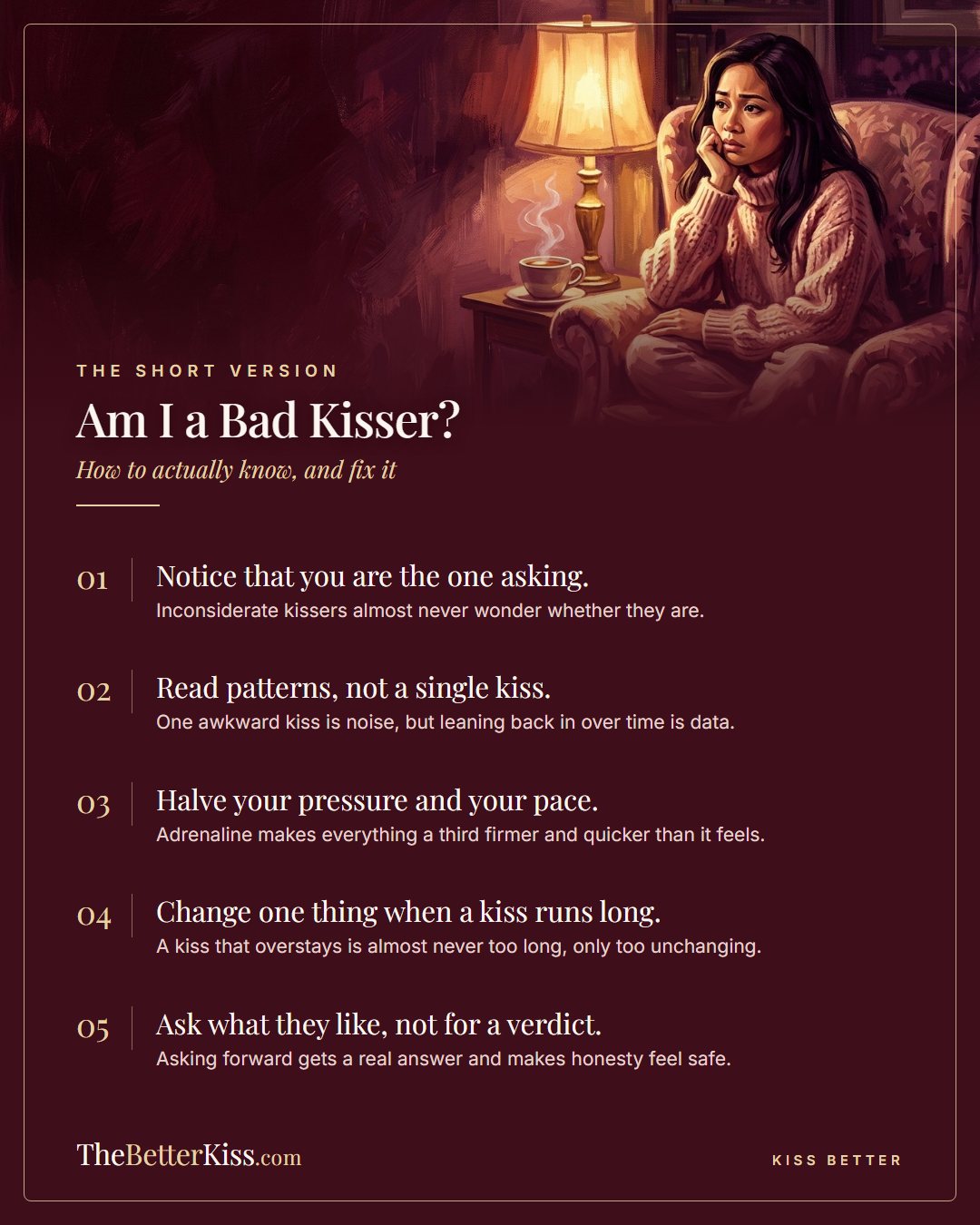
First: notice who's asking
People who are genuinely inconsiderate kissers almost never wonder if they are. The worrying itself is evidence of the single trait that makes kissers good: you care what the experience is like for the other person. You're likely not bad. You're likely anxious, which produces different symptoms — stiffness, rushing, over-monitoring — and has a different fix.
The honest signals worth reading
Not one kiss — patterns. Do people lean back in, or find reasons to wrap up? Does kissing with a partner get longer over time or shorter? Has anyone ever said “slower” or steered you with a hand? Those are data. One awkward kiss with one person is noise — first kisses are their own category, and they have their own guide — first kisses between any two people are clumsy because neither knows the other's rhythm yet.
What "bad" almost always actually is
Too hard, too fast, too much, too same. Every one of these is the anxiety signature: adrenaline makes everything a third firmer and quicker than it feels from inside, and self-monitoring makes you miss what they're doing back. Which reveals the real skill — kissing well is listening: match what they do, then vary one thing. The people described as amazing kissers aren't doing tricks. They're paying attention.
The four faults, and what each one actually is
Too hard. The most common, and almost always adrenaline rather than preference — under stress everything you do lands about a third firmer than it feels from inside. Halve it deliberately and you'll be roughly right.
Too fast. Same cause. Rushing reads as nervousness to the other person, not enthusiasm. The person who sets the slower pace nearly always reads as the more confident kisser.
Too much. Usually tongue, sometimes hands, occasionally both at once. The fix is thinking in phrases rather than continuous action: a touch, a response, a withdrawal.
Too same. The quietest fault and the one that makes kisses feel long. A kiss that overstays is almost never too long — it's too unchanging. One change resets everything.
How to know if you're a good kisser
Nobody hands out scores, so read what people do, not what they say. The reliable signs of a good kisser are all on the other person's side: they lean back in after a pause, they match your pace instead of fighting it, they relax into you instead of going stiff, and they come back for another kiss later without being asked. One of those is encouraging. Several, over time, is your answer.
The reliable signs of a kiss going badly are just as readable: pulling back early, turning it into a peck, going still, or steering your face somewhere else. None of them means you're a bad kisser. They mean this kiss, at this pace, wasn't right for this person, and the fix is nearly always slower, softer and less. The one skill that covers all of it is here.
Can you ask?
Yes, and it's less awkward than the years of wondering. Not "am I a bad kisser" — that hands your partner a test they'll fail politely. Ask forward instead: "what do you like?" or "tell me if you want it slower." You'll get a real answer, and you'll have done something more attractive than any technique: you'll have made it safe to be honest with you.
Soften the jaw (tension telegraphs). Halve your pressure and pace. Then the big one: put your attention on them — their breath, their pace, their answers — instead of on your performance. If the watching voice is the loudest thing in the room when you kiss, that's the actual thing to work on, and it's trainable — start here. For the mechanics themselves, the honest guide covers pressure, pace and hands.
If the nerves are the real problem
Knowing how isn't the same as being able to in the moment. The first module of our guided course is free: no card, no account, about ten minutes.
Start module one, free