How to Be a Good Kisser: The Complete Guide

Search this phrase and you'll get lists: forty-seven tips, ranked, as if kissing were a driving test. It isn't. Being a good kisser comes down to a single skill applied consistently — and once you see it, the forty-seven tips collapse into one.
On this page
- The one skill
- Match, then vary
- The mechanics that support it
- The mistake good instincts still make
- Signs you're already better than you think
- Ask. It's the fastest shortcut there is
- Can you practise on your own?
- Good kissing changes with the relationship
- What actually gets remembered
- Which is why anxiety is the real obstacle
- Quick answers
The one skill
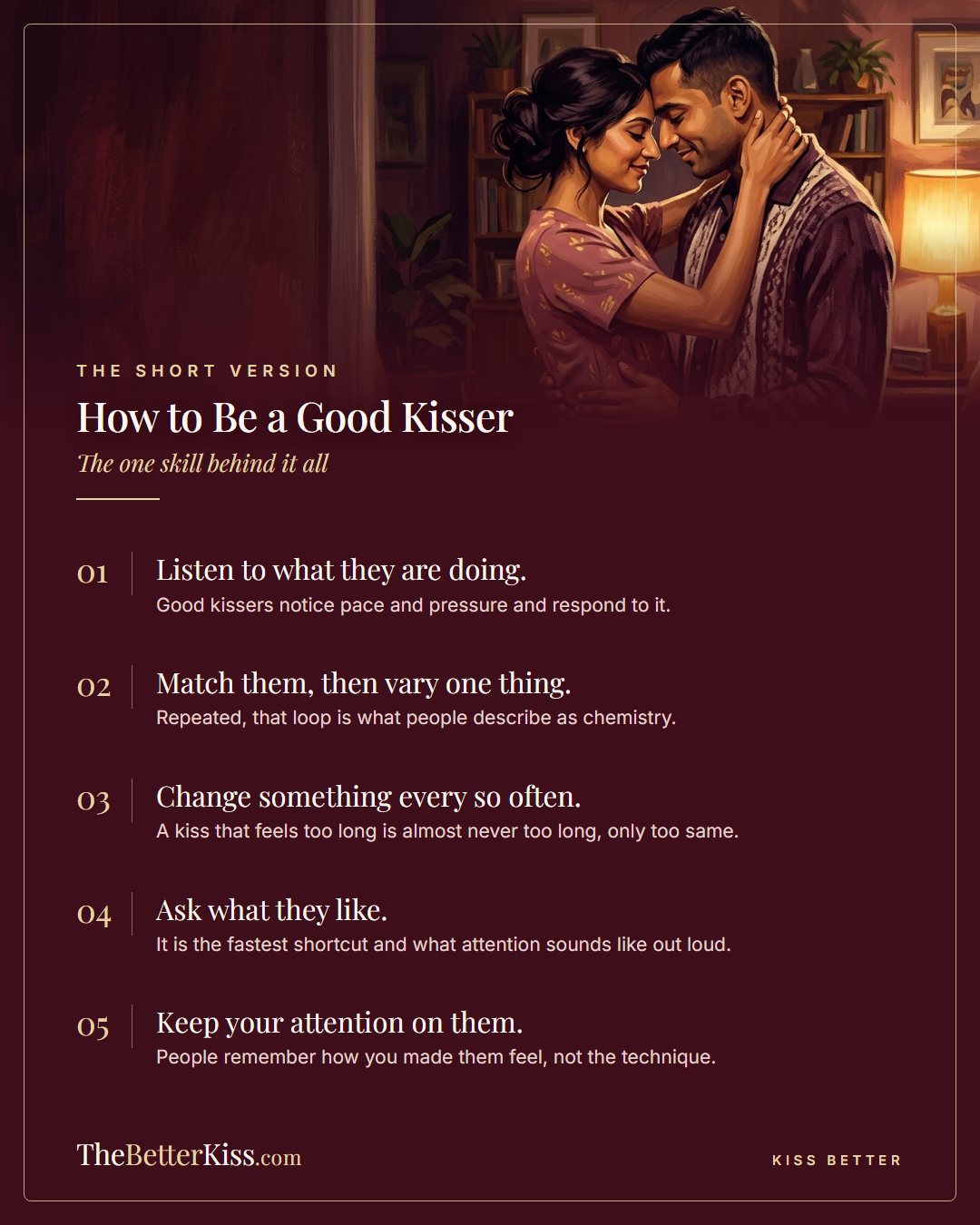
Good kissers are good listeners. The whole craft is noticing what the other person is doing and responding to it — their pace, their pressure, when they slow, when they lean in. That's it. It sounds too simple to be the answer, which is exactly why most people miss it and reach for technique instead.
The proof is in the counterexample: someone who has kissed forty people while thinking about their own performance is worse at this than someone who has kissed one person with real attention. Experience isn't skill. Attention is skill, and it's available from your very first kiss.
Match, then vary
Here's what listening looks like in practice, and it's the deep structure of every kiss anyone has ever called great. Match what they're doing long enough to be in the same conversation. Then change one thing — slightly slower, slightly softer, a pause. Match, vary. Match, vary. Repeated, that loop is what people describe afterwards as chemistry, and it is entirely learnable.
The mechanics that support it
Technique doesn't make you a good kisser, but bad technique can undermine a good instinct. So: soft jaw — tension starts there and travels straight to the lips. Pressure at about a third of what feels natural under adrenaline. Hands placed deliberately — the jaw, the neck, the waist — because hands doing nothing broadcast uncertainty. And the pause: breaking for one breath, staying close, is the most underused move there is. The full mechanical guide is here.
The mistake good instincts still make
Sameness. A kiss that feels too long is almost never too long — it's too same. Held pressure, unchanging rhythm, past the point of interest. One variation resets the entire thing. If you remember nothing else technical, remember to change something every so often.
Signs you're already better than you think
People who worry about this are rarely the problem; the genuinely careless kisser has never searched this phrase. A few honest markers that you're doing fine: the other person leans back in after a pause. They slow down with you rather than pulling away. They smile or exhale when you break. They kiss you again, later, unprompted. None of these is about technique. All of them are about someone feeling attended to. If you want the fuller self-check, here's how to actually know.
Ask. It's the fastest shortcut there is
Every person likes something slightly different: softer, slower, more pressure, less tongue, hands in their hair or definitely not in their hair. You can spend six months inferring it, or you can ask. “What do you like?” and “Slower or like this?” are not admissions of incompetence. They're what attention sounds like out loud, and the person asking them is, almost by definition, the good kisser in the room.
The reverse holds too. Saying what you like — “softer,” “stay there,” “kiss me like you did earlier” — makes your partner better and takes the guesswork off both of you.
Can you practise on your own?
Not the kiss itself. The back of a hand teaches you nothing, because it doesn't respond and responding is the entire skill. What you can practise alone is the thing underneath it: attention. Pick any ordinary conversation today and put your whole attention on the other person for thirty seconds — their pace, their expression, when they pause. That's the same muscle. You can also practise the two physical habits that matter: letting your jaw go slack on purpose, and breathing slowly through your nose. Both are learnable in a bathroom mirror in under a minute.
Good kissing changes with the relationship
On a first kiss, good means careful: slow, soft, short, and clearly welcome. Three months in, good means varied — different kinds of kisses at different moments, not the same one on repeat. Ten years in, good mostly means still doing it on purpose. The kiss hello that lasts long enough to notice. The one that isn't a prelude to anything. Long-term couples don't usually lose the skill. They lose the habit, and the habit is the easier one to get back.
What actually gets remembered
Here's the part that should take the pressure off entirely: almost nobody remembers whether a kiss was technically excellent. What people remember, for years, is how the other person made them feel — attended to, wanted, unhurried, and kindly treated if it was awkward. Those are not techniques. They're the by-product of your attention being on them instead of on your own performance.
Which is why anxiety is the real obstacle
If you struggle to be a good kisser, the cause is almost never a skills deficit — it's that anxiety pulls your attention inward, onto the audit of how you're doing, exactly when it needs to be outward, on them. Psychologists call the self-watching spectatoring, and it produces the very stiffness it fears. The route to being a good kisser and the route out of kiss anxiety turn out to be the same road: attention outward. If the nerves are your real obstacle, start here.
Quick answers
Does experience make you a good kisser? Less than you'd think. Attention does. An attentive beginner beats a distracted veteran.
What's the single biggest turn-off? Too much, too soon: pressure, speed, tongue. Halve all three and you've fixed most of what people complain about.
Does a bad first kiss doom things? A first kiss carries real weight for many people, which is a reason to go slowly, not a reason to panic. A slightly awkward kiss followed by a laugh and a better second one is how a great many good relationships began.
Is kissing a woman different from kissing a man? Less than the internet suggests; people vary more than genders do. What does hold up is in how to kiss a woman and how to kiss a man.
How do I get more confident? By doing small versions of the frightening thing, not by reading more. The mechanism is explained here.
One standing rule, here as everywhere on this site: none of this is a method for turning a no into a yes. A kiss that isn't wanted isn't a kiss worth having, and asking twice is pressure, not persistence.
If the nerves are the real problem
Knowing how isn't the same as being able to in the moment. The first module of our guided course is free: no card, no account, about ten minutes.
Start module one, free