Why Do People Enjoy Kissing? The Psychology of the Kiss
We've written about the physical machinery of why kissing feels good — the dense nerve endings, the lips' outsized share of the brain's body map. But that explains sensation, not meaning. Why does a kiss feel significant in a way that other pleasant touches don't? The answer is psychological, and it's more interesting than the biology.
On this page
Undivided attention, made physical
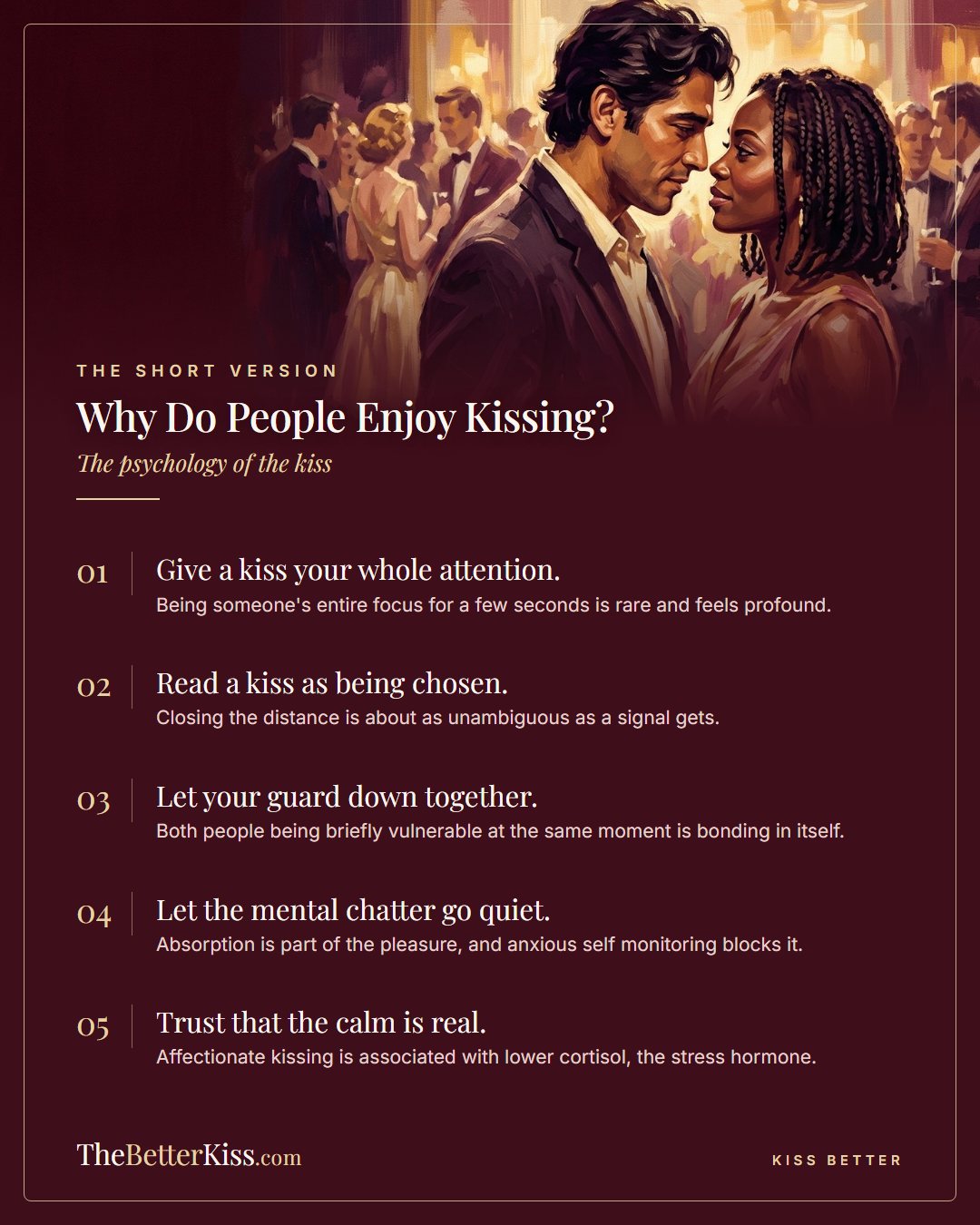
A kiss is one of the few human acts that is almost impossible to do while distracted. It requires proximity, coordination, and — done well — your whole attention. To be kissed properly is to be, for a few seconds, the entire content of someone else's awareness. In a world of divided attention, that's rare enough to register as profound.
Being chosen at close range
Attraction from across a room is cheap; anyone can be admired at a distance. A kiss collapses the distance to zero and the choice becomes undeniable: this person wants to be this close to you, specifically. Psychologists studying attachment note how powerfully humans respond to unambiguous signals of being chosen. A kiss is about as unambiguous as signals get.
The vulnerability exchange
Closing your eyes, letting someone into your personal space, offering a soft and undefended part of yourself — a kiss is a small, mutual act of trust. Each person makes themselves briefly vulnerable at the same moment, and that synchronised lowering of the guard is bonding in itself. It's not incidental that we don't kiss people we don't trust.
The absorption effect
Part of the pleasure is what a kiss removes: for its duration, the mental chatter quiets. Your eyes close — the brain literally dims vision to feel touch better — and the world narrows to warmth and breath. This absorption is close to what people seek in meditation, arriving free and involuntarily. Which explains the unhappy converse: a kiss experienced while anxiously self-monitoring barely registers, because the absorption never happens. The enjoyment was never only in the lips. It was in the attention. Which is exactly what anxiety steals.
Why it can mean so much, so fast
Attention, being chosen, mutual vulnerability, and total absorption — delivered in a few seconds, at point-blank range. That's a remarkable amount of psychological signal for such a small act, and it's why a single kiss can reorganise how two people feel about each other. The nerve endings explain the pleasure. The psychology explains the weight.
If the nerves are the real problem
Knowing how isn't the same as being able to in the moment. The first module of our guided course is free: no card, no account, about ten minutes.
Start module one, free