What Kissing Does to Your Body: The Science
Kissing has a publicity problem: it's treated as the trailer before the main feature. The research says otherwise — emphatically. Here's what actually happens, according to studies rather than magazines. (For the moment-to-moment version — why it feels like that — see why kissing feels good.)
On this page
The finding that should be famous
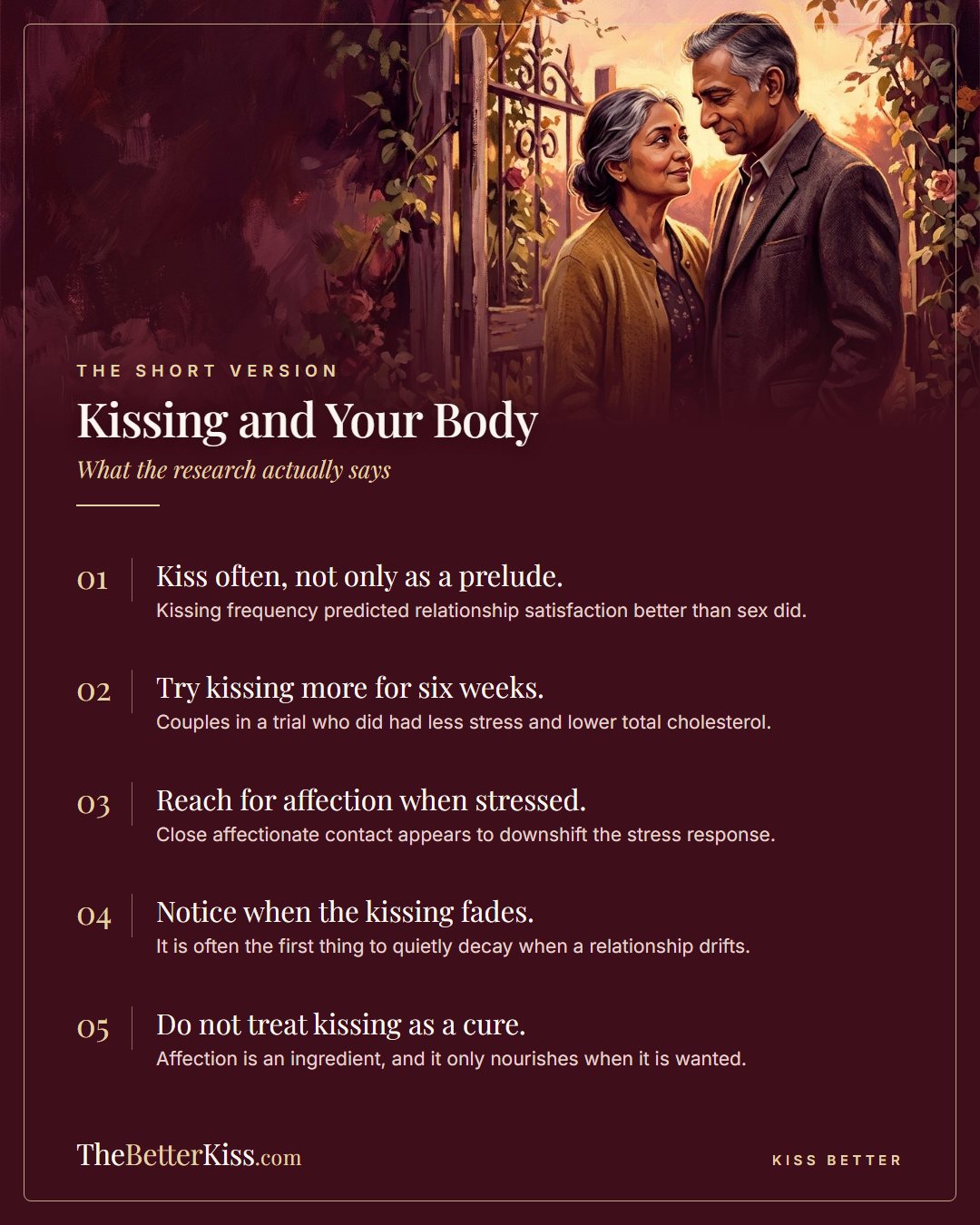
In 2013, Oxford researchers Rafael Wlodarski and Robin Dunbar surveyed over 900 adults about their relationships. The result: how often couples kissed predicted how satisfied they were with the relationship — and how often they had sex didn't carry the same predictive weight. Read that twice. Kissing frequency told researchers more about a relationship's health than sex frequency did.
It's causal, not just correlated
The plausible mechanics: close affectionate contact downshifts the stress response — related work has shown that a partner's touch can quiet the brain's threat systems and that affection improves how couples handle conflict. The kiss appears to be one of the most efficient delivery systems for that effect we have.
What a kiss is measuring
Why would kissing carry so much signal? One theory: a kiss is an unusually honest instrument. It requires proximity, attention, and willingness in a way a habit can't fake — which may be why it's often the first thing to quietly decay when a relationship drifts, long before anyone names the distance. The couples who keep kissing, the data suggests, keep each other.
An honest note
If the nerves are the real problem
Knowing how isn't the same as being able to in the moment. The first module of our guided course is free: no card, no account, about ten minutes.
Start module one, free