Kissing and Oxytocin: The 'Love Hormone' Myth, Examined
Every article about kissing eventually deploys the same sentence: kissing releases oxytocin, “the love hormone,” which bonds you to your partner. It's tidy, it's everywhere, and the evidence behind it is a mess worth understanding — because the true story is better.
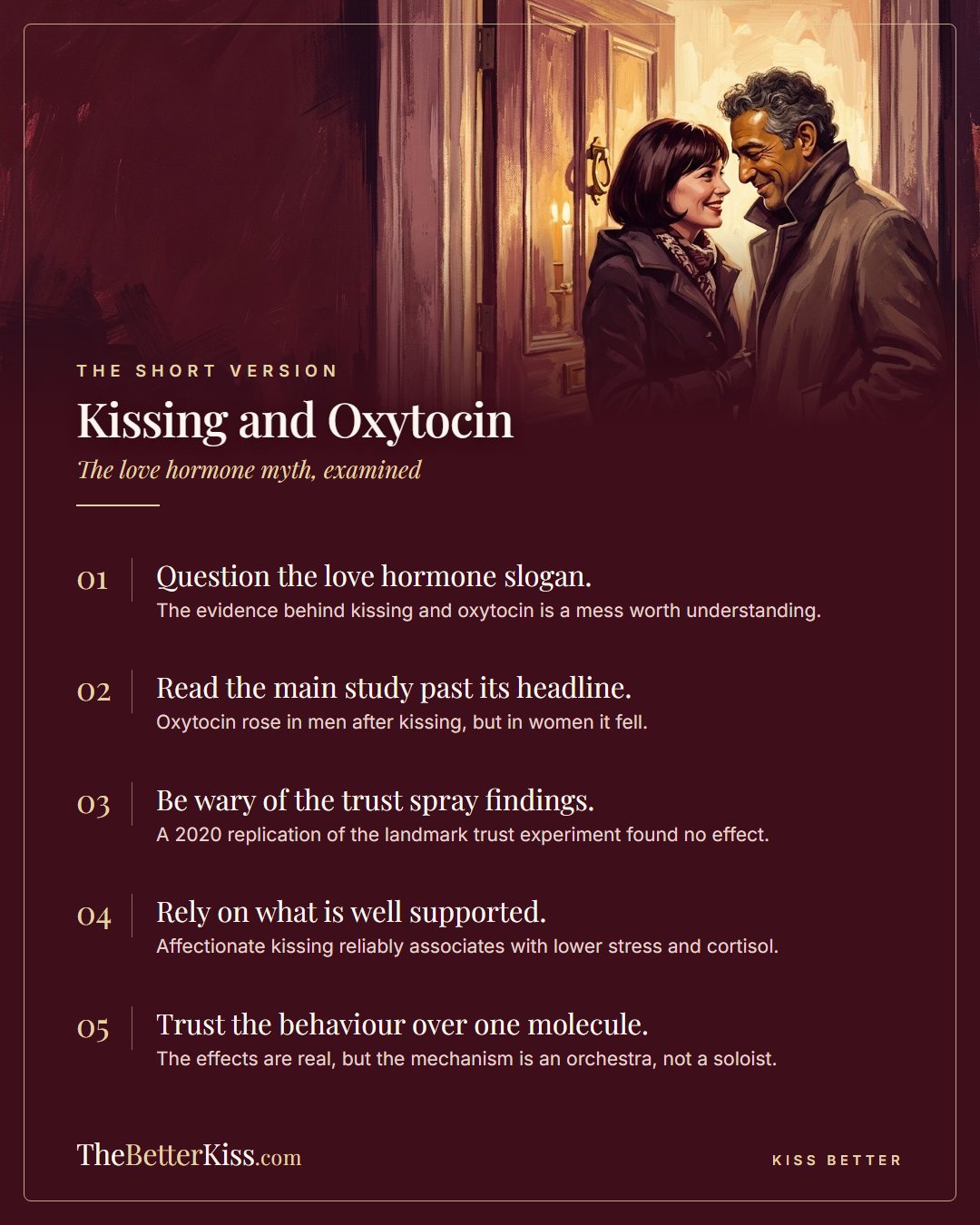
The study nobody reads past the headline of
Interpretations vary — the researchers noted context may matter enormously for women (a lab room with electrodes is not a candlelit doorway) — but the finding alone should end the one-hormone fairy tale.
The bigger wobble
Oxytocin's pop-science career was launched by studies claiming a nasal spray of it increased trust between strangers. Later, larger attempts to replicate those famous results failed — a 2020 replication of the landmark trust experiment found no effect. The molecule is real and matters in bonding biology; the “sprinkle oxytocin, get love” model does not survive contact with the replication literature.
What's actually true
Affectionate kissing reliably associates with lower stress — reduced cortisol — and with relationship outcomes that no single hormone explains: kissing frequency predicts satisfaction better than sex frequency (Wlodarski & Dunbar, 2013), and instructed increases in kissing improved stress and even cholesterol in a randomised trial (Floyd, 2009).
In other words: the effects are real and measurable; the mechanism is an orchestra, not a soloist. Distrust anyone selling you a single molecule — and trust the behaviour, which keeps outperforming its own explanations. See also: the mechanisms that are well supported.
If the nerves are the real problem
Knowing how isn't the same as being able to in the moment. The first module of our guided course is free: no card, no account, about ten minutes.
Start module one, free