The Forehead Kiss: What It Actually Says
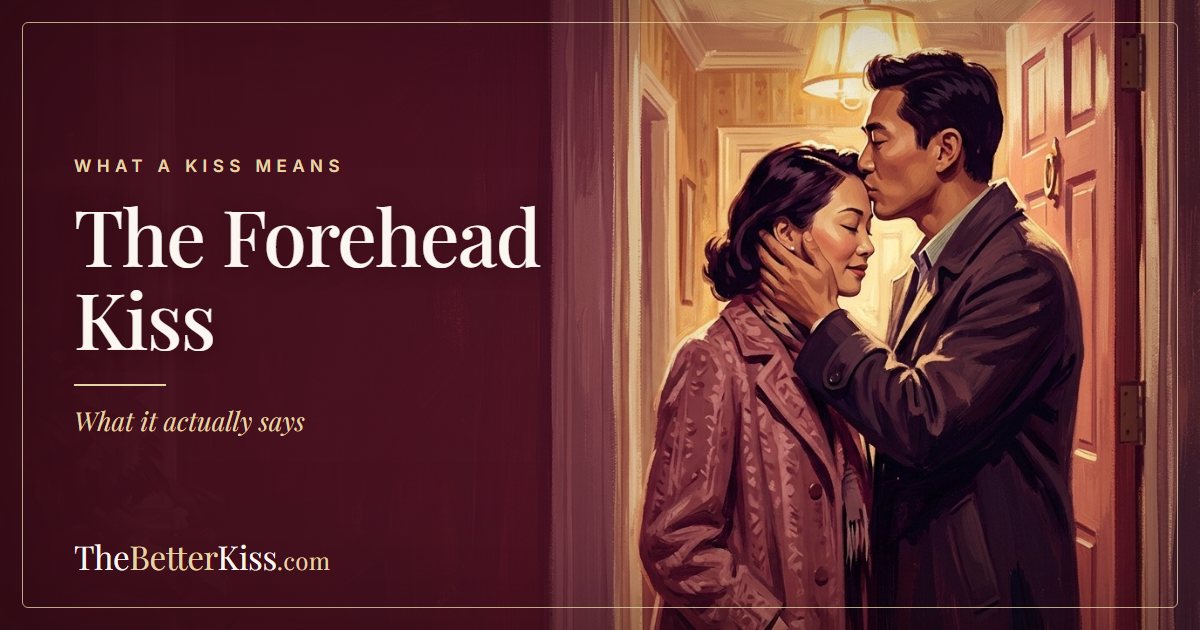
Ask people about the most romantic kiss they've ever received and a strange pattern shows up: a remarkable number of them describe a kiss that wasn't on the lips at all. The forehead kiss — the least sexual kiss in the vocabulary — is somehow the one that gets remembered years later. It's worth understanding why — and where it sits in the wider vocabulary of kisses.
On this page
What it says
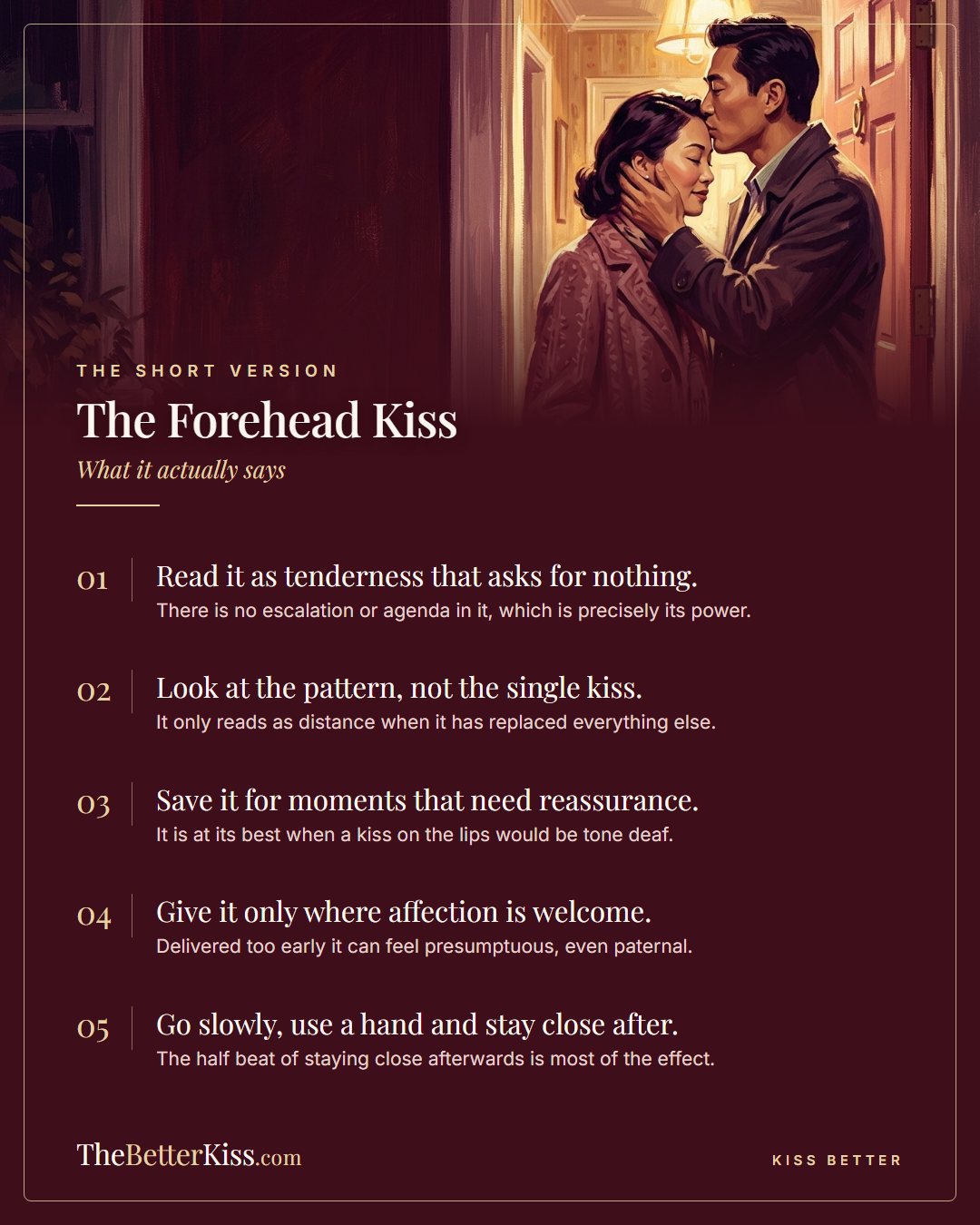
Every kiss is a sentence, and the forehead kiss says something specific: I'm keeping you. It spends tenderness without asking anything back. There's no escalation in it, no question, no agenda — which is precisely its power. It's affection with the transaction removed.
That's also why it lands so differently from a kiss on the lips. A lip kiss opens a conversation; a forehead kiss closes a loop. It says the moment is already complete.
What it means from different people
From a partner. Security. It's the kiss of someone who isn't trying to win you because they consider the matter settled. People often read it as the moment a relationship stopped being a performance.
From someone you're dating. Usually: I like you beyond wanting you. It tends to appear when feelings have got ahead of the timeline, which is why it can feel bigger than a first kiss on the lips.
From a friend or family member. Care and protection, with no romantic content at all. This is the kiss's original job.
Does it mean they're not attracted to you? Almost never, on its own. People worry that a forehead kiss is a polite downgrade. Look at the pattern instead of the single kiss: if it arrives alongside other affection, it's an addition. It only reads as distance when it has replaced everything else.
The oldest kiss we have
Long before the kiss belonged to lovers, it belonged to blessing: parents to children, elders to the young, the living to the dying. The forehead is where that kiss has always landed, across a great many cultures and faiths. So when a forehead kiss feels weightier than its size, that isn't sentimentality. You're being spoken to in the oldest register the gesture has.
When it belongs
After laughter. After hard days. In doorways, at the end of the evening, when someone is tired or worried or has just told you something that cost them. On the top of a head resting on your shoulder. The forehead kiss is at its best precisely when a lip kiss would be tone-deaf — when what the moment needs is reassurance rather than heat.
The one requirement
Like every kiss in the vocabulary, it's for someone who has already welcomed your affection. Delivered too early — before you've established that this register of tenderness is wanted — it can feel presumptuous, even paternal. The forehead kiss is a sentence in an established language, not an opening line.
How to give one
Slowly, and with your hands. A hand at the side of their face or the back of their head is what turns it from a peck that missed into a forehead kiss. Lips soft, a full second of contact, and don't rush away afterwards; the half-beat of staying close is most of the effect. It works standing, in a doorway, on a sofa, and particularly well when they're mid-worry and didn't see it coming.
How to receive one: you don't have to do anything. Lean in, close your eyes, let it finish. That's the correct reply.
And if you don't like them — some people find the gesture parental — say so kindly. “I love you being gentle with me, just not there” costs nothing and saves years of small flinches.
Why it disarms
Most affection carries a question mark: is this okay, is this going somewhere, what happens next. The forehead kiss is one of the only gestures with a full stop at the end. Being on the receiving end of affection that wants nothing is rare enough that people remember it — which is why, years later, it's the one they describe. In a vocabulary of kisses, learn this word early — then learn the one that says desire persists. It's the tenderest thing you can say without speaking.
If the nerves are the real problem
Knowing how isn't the same as being able to in the moment. The first module of our guided course is free: no card, no account, about ten minutes.
Start module one, free