The Neck Kiss: What It Says and Why It Works

A kiss on the lips is a conversation. A kiss on the neck is a statement — and the statement is: I'm paying attention to you, specifically, and I'm not in a hurry. It's one entry in the full vocabulary of kisses.
On this page
Why it lands so hard
Partly nerve density: the neck is rich in sensitive nerve endings and thin skin, so light contact registers vividly. But mostly meaning. The neck is undefended — offering it requires trust, and kissing it acknowledges that trust. It's also specific: a lip kiss is the default, but a neck kiss was chosen, which is exactly why it reads as attention rather than habit.
What it means when someone kisses your neck
Three things, usually at once. Desire — this is not a kiss anyone gives absent-mindedly. Familiarity — it assumes a closeness that a kiss on the lips doesn't. And attention — they chose a place that is yours specifically, which is why it can feel more personal than a kiss on the mouth.
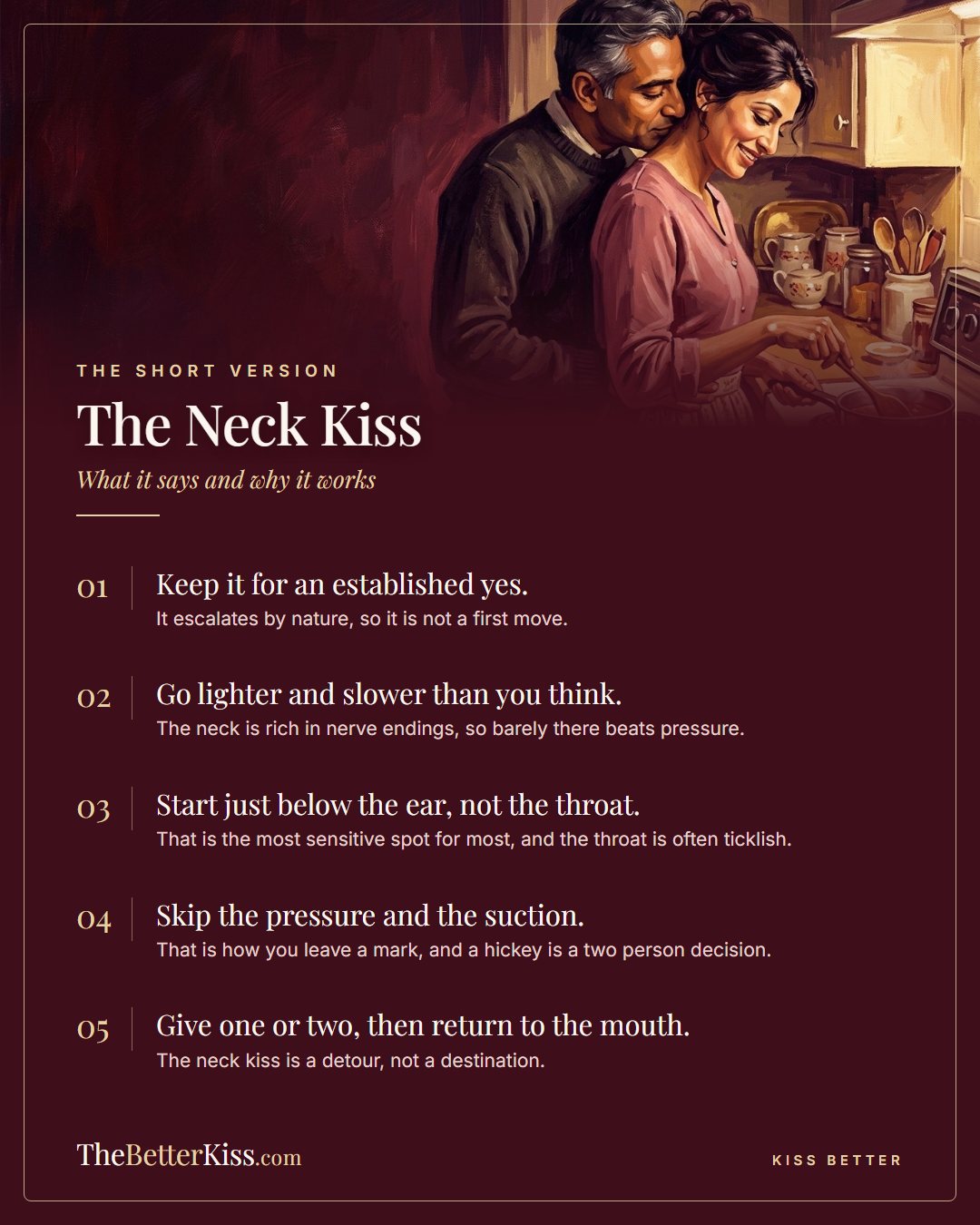
From a long-term partner in the kitchen, it means I still want you. From someone new, mid-kiss, it means I'd like this to go further — and you get to decide whether it does.
How, briefly
Lighter than you think — the nerve density does the work, so barely-there beats pressure. Slow. The area just below the ear and along the side, not the throat. Warm breath is part of the instrument. And brevity keeps it a sentence rather than a speech: one or two, then return.
Where, exactly
Just below the ear. The most sensitive spot for most people. Start here.
The side of the neck. Slow, soft kisses moving down toward the shoulder. Two or three, not a dozen.
The nape. From behind, with their hair moved aside. The most disarming version, because it arrives unannounced — which is exactly why it's only for someone who has already made clear they welcome it.
Where the neck meets the shoulder. The gentlest of the four, and the one that fits most naturally into ordinary life.
Leave the front of the throat alone unless you know it's liked. For many people it's ticklish or simply uncomfortable.
The mistakes
Too wet. Dry, soft lips. Always.
Too much pressure, or suction. That's how you leave a mark. A hickey is a bruise that stays visible for days and that the other person then has to explain at work, so it is a two-person decision and you ask first. Nobody's folk remedy removes one.
Staying too long. The neck kiss is a detour, not a destination. Go back to their mouth.
Using it as an opening move. On someone who hasn't yet kissed you back, it's too much, too early. Begin at the beginning.
The rule
This is an established-yes kiss. It escalates by nature, and it belongs where escalation is already welcome — it is not a first move, and it's a poor test balloon. With someone new, the lips are the front door; the neck is a room you get shown.
If you're on the receiving end
You're allowed an opinion, and you're allowed to voice it mid-kiss. If you like it: tilt your head, lean in, or say so — people are rarely told what's working and are grateful when they are. If you don't, or not yet: “not there” or “slow down” is a complete sentence, and a decent partner hears it as information, not rejection. Anyone who sulks at it has told you something useful about themselves.
In long relationships
Here's the quiet superpower: the neck kiss survives domesticity. Years in, a kiss on the neck while someone's cooking says I still notice you in a way a routine peck can't — because it's still chosen, still specific. In the vocabulary of kisses, it's the word for desire that persists — the counterpart to the forehead kiss's tenderness.
If the nerves are the real problem
Knowing how isn't the same as being able to in the moment. The first module of our guided course is free: no card, no account, about ten minutes.
Start module one, free