Types of Kisses: The Complete Vocabulary
A kiss is a sentence, and most people only ever say one thing. Here is the vocabulary — what each kiss says, because the meaning, not the mechanics, is what makes each one land. For the mechanics themselves, see the honest guide; for the customs that govern greeting kisses, the field guide.
On this page
- The slow first kiss
- The French kiss
- The forehead kiss
- The neck kiss
- The cheek kiss
- The hand kiss
- The interrupting kiss
- The goodbye kiss
- The stolen kiss
- The lip bite
- The eskimo and butterfly kisses
- The shoulder kiss
- The kiss on the wrist or palm
- The peck
- The single-lip kiss
- The nose kiss
- The earlobe kiss
- The upside-down kiss
- The kiss in the rain
- The morning kiss
- The make-up kiss
- The passionate kiss
- The six-second kiss
- How to choose the right one
- Which kisses actually matter?
The slow first kiss
Says: I've thought about this. Half speed, soft, one pause inside it. A first kiss is a signature — never rush a signature. Full guide here.
The French kiss
Says: more. An escalation, always by invitation. Tongue as seasoning, not main course — the honest guide.
The forehead kiss
Says: I'm keeping you. Tenderness with the transaction removed — the one people describe years later. Why it disarms everyone.
The neck kiss
Says: I'm paying attention to you, specifically. Intimate enough to be reserved for established yeses. More here.
The cheek kiss
Says: warmth, within the rules. The most context-dependent kiss on earth — one cheek in Latin America, two in France, sometimes three in the Netherlands. The field guide.
The hand kiss
Says: I'm making a small ceremony of you. Antique, theatrical, and — deployed with a glint of self-awareness — devastating.
The interrupting kiss
Says: I couldn't wait. Mid-sentence, brief, smiling. The charm is in returning them to their sentence.
The goodbye kiss
Says: this mattered. The doorway kiss gets replayed on the drive home. Unhurried, with a held beat of eye contact after — the pause is half the kiss.
The stolen kiss
Says: you delight me. Hairline, shoulder, temple, apropos of nothing. One law: stolen kisses are for people who've already said yes to being kissed by you. With someone new, nothing is stolen — everything is offered.
The lip bite
Says: I'm not finished. A gentle catch of their lower lip as a kiss breaks — punctuation rather than a move. Light, brief, and only where the register is already playful. Overdone it becomes theatre.
The eskimo and butterfly kisses
Say: I'm being silly with you. Noses brushing; eyelashes fluttering against a cheek. Almost childlike, and that's the point — they signal a kind of safety that intensity can't. Underrated in long relationships, where playfulness is usually the first casualty.
The shoulder kiss
Says: I'm here and I'm not going anywhere. Domestic, unhurried, often from behind while someone's doing something else. The kiss of ordinary life, and one of the most quietly loved.
The kiss on the wrist or palm
Says: I noticed you specifically. An old, deliberate gesture. Slow enough to be unmistakable, rare enough to land.
The peck
Says: hello, I'm fond of you. Quick, closed, light. The workhorse of long relationships and the safest first kiss there is. Its only risk is becoming the only kiss you give.
The single-lip kiss
Says: I'm taking my time. Your lips around just their upper or lower lip, gently. The simplest way to make an ordinary kiss feel deliberate, and the natural step between a peck and anything deeper.
The nose kiss
Says: you're mine to be gentle with. A kiss on the tip or bridge of the nose. Close cousin of what English calls the “eskimo kiss”, which is properly the Inuit kunik: pressing nose and upper lip to someone's skin and breathing in. It's usually familial, often for children — affection as breath, not a cartoon nose-rub.
The earlobe kiss
Says: I know what you like. A kiss or the lightest catch of the lips just at the ear. Like the neck kiss, strictly for an established yes, and better whispered than announced.
The upside-down kiss
Says: let's be ridiculous together. Known everywhere as the Spider-Man kiss, after the 2002 film. One of you is lying down, the other leans in from above the head. The novelty is the fun; the chins take some negotiating.
The kiss in the rain
Says: I'd rather be here than dry. Cinema's favourite, and worth doing once on purpose. The trick is that nobody plans to stay out in it, so it only works if you decide the rain doesn't matter.
The morning kiss
Says: you first, then the day. Closed-mouth, brief, before the phone. Small, daily, and one of the kisses long-term couples say they'd miss most.
The make-up kiss
Says: we're all right. The kiss after an argument has been properly finished — not instead of finishing it. Used too early it reads as changing the subject. How to get it right.
The passionate kiss
Says: I want you, and I'm not hiding it. Less a type than a temperature: closer, slower, hands involved. It's built from the same parts as every other kiss on this page, with the restraint taken off by mutual agreement.
The six-second kiss
Says: I still choose this. A daily practice from relationship therapy: six seconds because you can't do six seconds on autopilot. The cheapest relationship maintenance ever devised.
How to choose the right one
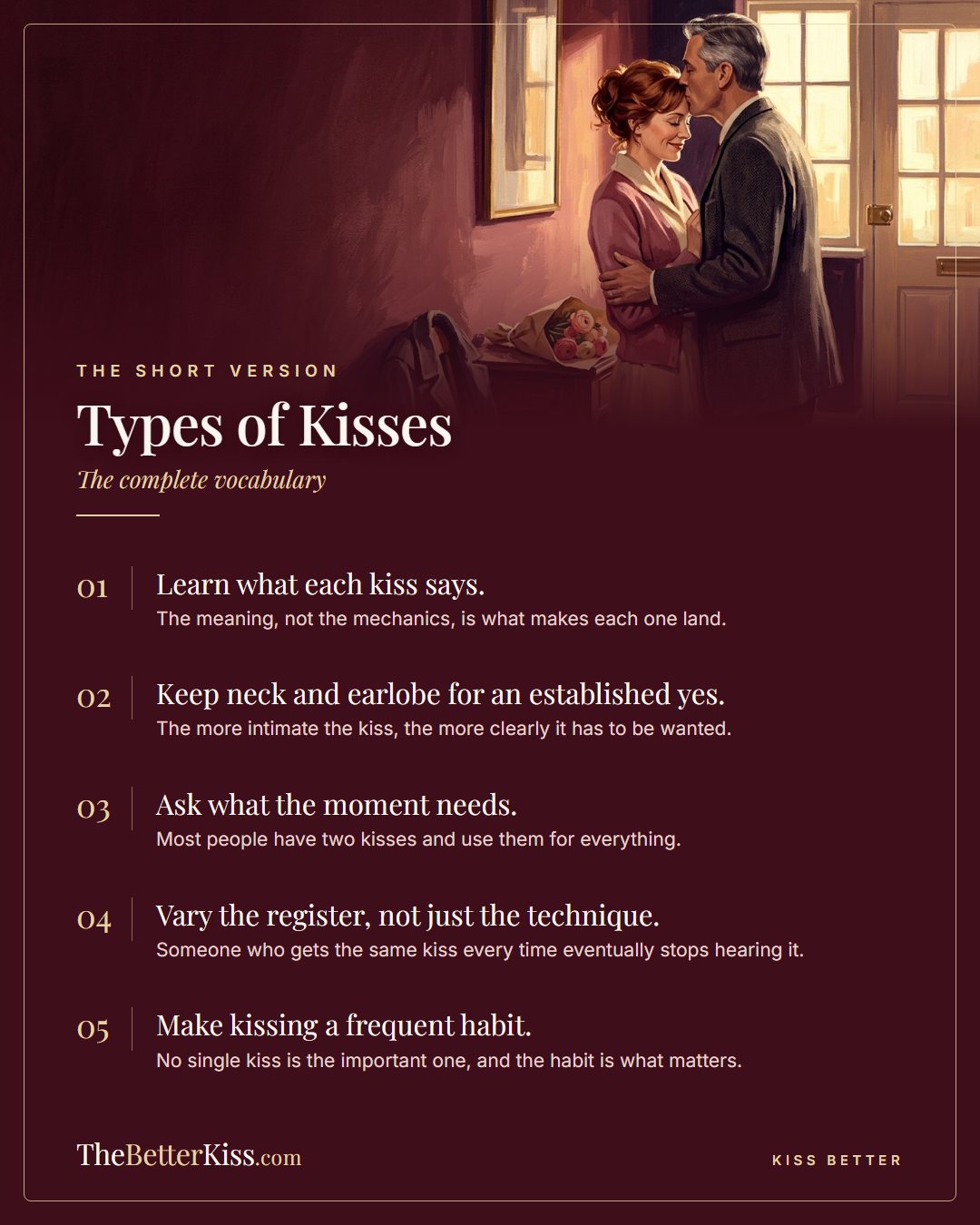
Ask what the moment needs, not what you know how to do. Reassurance: forehead, shoulder, hand. Play: nose, upside-down, interrupting. Heat: neck, earlobe, single-lip, French. Ritual: morning, goodbye, six-second. Most people have two kisses and use them for everything, which is like owning a piano and playing one note.
And one boundary that covers the whole list: the more intimate the kiss, the more clearly it has to be wanted. With someone new, lips first, gently, and only when the moment or the answer is a clear yes. Here's how to tell.
Which kisses actually matter?
The frequent ones. Oxford researchers found that how often couples kiss predicted how satisfied they were with the relationship, and that frequency of sex did not (Wlodarski & Dunbar, 2013). No single kiss on this page is the important one. The habit is. If you want to get better at any of them, it comes down to one skill.
The principle under all of it: vary the register, not just the technique. Someone who receives the same kiss every time eventually stops hearing it. Someone who gets tenderness, mischief, and gratitude — each at its right moment — never does.
If the nerves are the real problem
Knowing how isn't the same as being able to in the moment. The first module of our guided course is free: no card, no account, about ten minutes.
Start module one, free