Kissing Tips That Actually Work (and the Myths to Ignore)
“Kissing tips” is one of the most searched and worst-served phrases on the internet — an ocean of recycled listicles, half of them repeating advice that actively makes kissing worse. Here's the honest sort: what works, what's noise, and what to actively unlearn.
On this page
Tips that actually work
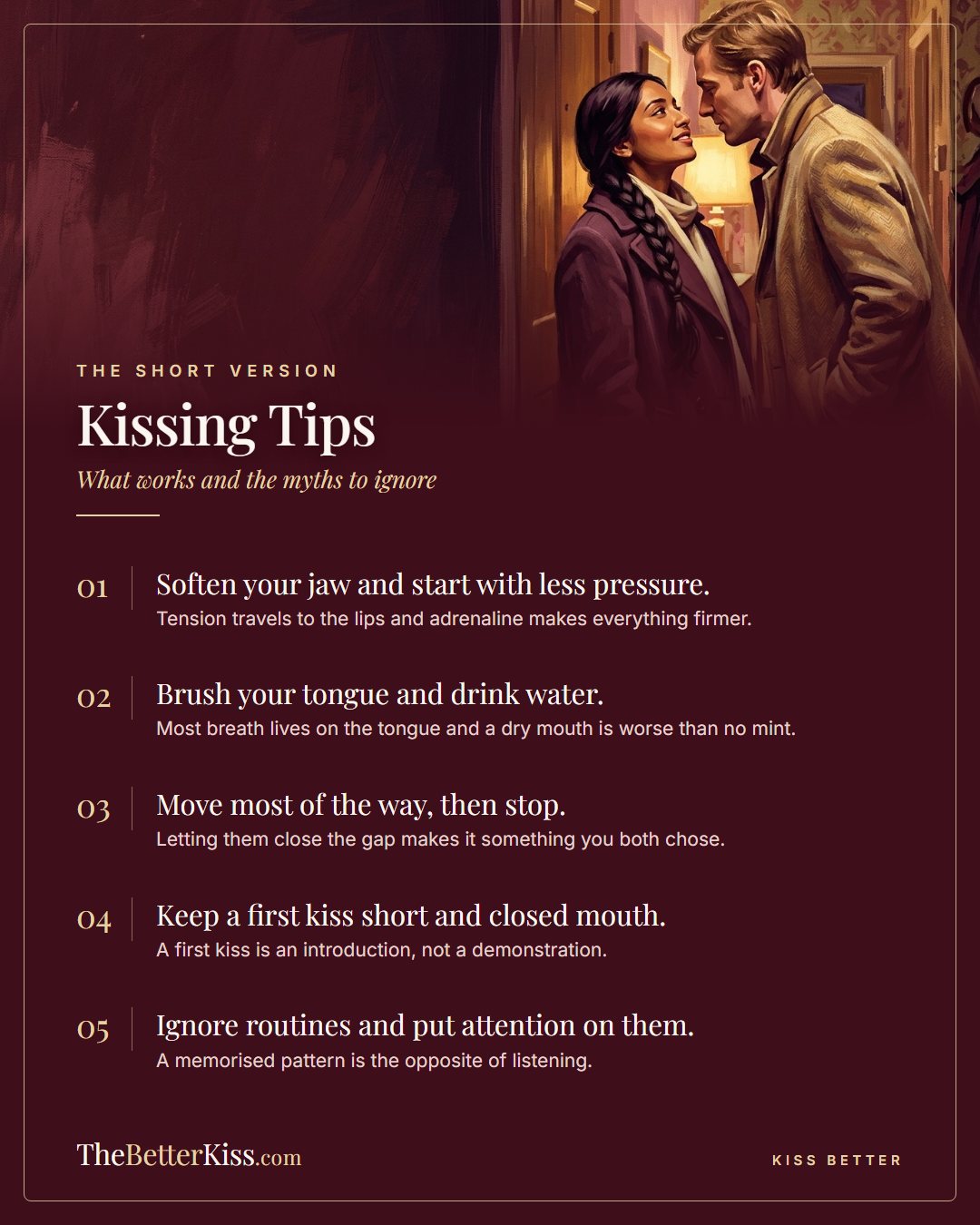
Soften your jaw before you start. Tension begins there and travels straight to the lips. This single adjustment fixes more “bad” kissing than any other.
Start with less pressure than feels natural. Adrenaline makes everything a third firmer than it feels from inside. You can always build; you can't un-lunge.
Match, then vary. Meet their pace and pressure, then change one small thing. This is the actual engine of a good kiss. More on the one skill here.
Use the pause. Breaking for a single breath, staying close, makes the return feel chosen. Great kisses have punctuation.
Put your hands somewhere deliberate. The jaw, the neck, the waist. Hands doing nothing undermine everything else.
Say something warm afterward. The two seconds after the kiss are where the memory gets written.
Before the kiss: the unglamorous part
Breath. Brush, and brush your tongue, which is where most of it lives. Water beats mints on a date; a dry mouth is worse than an unminted one. Go easy on garlic and coffee beforehand, or make sure you both had them.
Lips. Lip balm an hour before, not a minute before. Thick gloss and fresh balm are a texture most people don't enjoy.
Timing. The best moment is usually a quiet one: a pause in conversation, a goodbye, a held look. If you're waiting for certainty, you'll wait forever. Look for the pause instead, or ask.
The approach. Move most of the way and stop. Let them close the last part. It turns a kiss from something you did into something you both chose, and it gives them an easy, graceful way to say not yet.
Tips for a first kiss with someone new
Keep it short. Keep it closed-mouth unless they clearly want more. Pull back after a few seconds and look at them — the smile you get, or don't, tells you everything about what comes next. A first kiss is an introduction, not a demonstration. The full first-kiss guide is here, and if it's a first kiss with someone you've known a while, that's its own situation.
Tips for people who've been together for years
Kiss when it isn't leading anywhere. Once every kiss is either a peck or a prelude, kissing itself quietly disappears. Bring back the middle register.
Try the six-second kiss. Once a day, for six seconds, because you can't do six seconds on autopilot. It sounds like a gimmick and works like a reset. Save a longer one for the anniversary kiss.
Change the location. The same kiss in the hallway, the kitchen or the car lands as a different sentence (and in public it has its own etiquette). So does a kiss on the neck or the forehead instead of the lips.
Tips that are just noise
“Eat strawberries first” and similar — harmless, irrelevant. “Follow the number 8 with your tongue” and any other choreography — actively bad, because a memorised pattern is the opposite of listening. “Always tilt right” — you'll both tilt and it sorts itself out. Most numeric, prescriptive tips fail for the same reason: they put your attention on executing a routine instead of on the person, which is exactly backwards.
Advice to actively unlearn
“Be dominant / take control.” This produces the too-hard, too-fast, too-much kiss that people politely endure. Confidence in kissing looks like calm, not force — the person who sets the slower pace almost always reads as the better kisser.
“Have a few drinks to loosen up.” A crutch that keeps anxiety alive, because you learn you only managed with it — and it blurs your read of whether the kiss is even wanted. Why safety behaviours backfire.
“Just go for it, hesitation is unattractive.” This is how misreads happen. Reading the moment or asking isn't hesitation; it's the difference between a welcome kiss and one that needs recovering from. Read the moment properly instead.
Quick answers to the usual questions
Eyes open or closed? Closed, mostly. It isn't a rule; it's that closing them lets you pay attention to what you feel. The longer answer is here.
Which way do I tilt? Most couples go right. If you both go the same way and bump noses, laugh and adjust. That's a good sign, not a failure.
How much tongue? Less than you think, later than you think, and only if it's being returned. The honest French-kiss guide covers it.
What if it's awkward? It will be, occasionally, for everyone. Smile, say something kind, and try again. Awkwardness handled warmly is more attractive than smoothness.
What if they say not yet? Then the answer is “of course,” said like you mean it, and the evening carries on. How someone takes a no tells the other person more about them than any kiss could.
The tip underneath all the tips
If you internalise one thing: put your attention on them, not on you. Every genuine tip above is a way of doing that; every bad one is a way of doing the opposite. Kissing well isn't a performance you execute — it's attention you pay.
If the nerves are the real problem
Knowing how isn't the same as being able to in the moment. The first module of our guided course is free: no card, no account, about ten minutes.
Start module one, free