How to Kiss Someone for the First Time (in a Relationship)

Most first-kiss advice imagines strangers — a date, a bar, uncertainty. But a great many first kisses happen between people who already know each other: friends crossing a line, a few dates deep, a slow build that's finally ready to tip. That first kiss has a different texture, and it deserves its own guide.
On this page
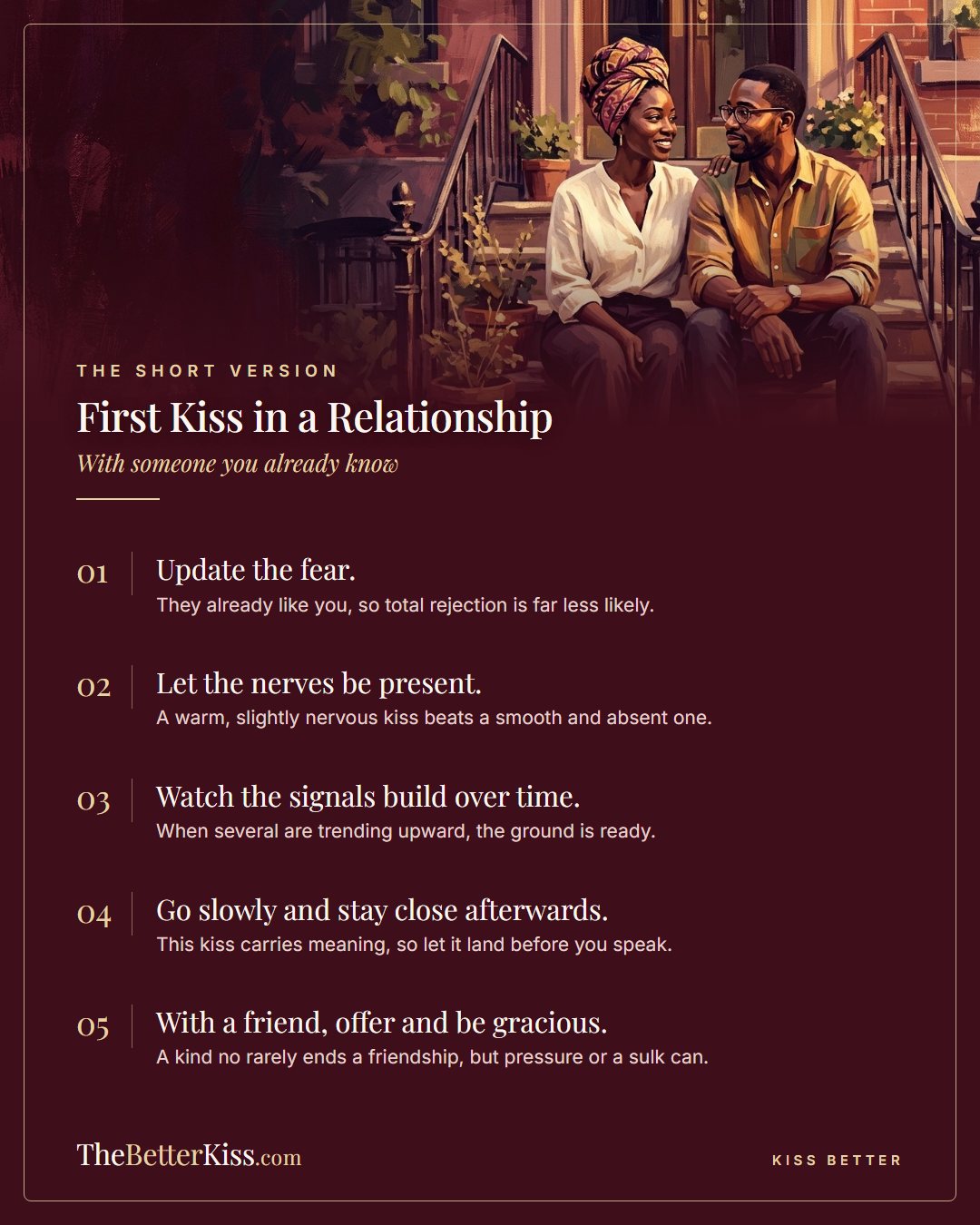
The stakes are lower than you're telling yourself
If you're already dating or close, you have information a stranger never gets: they like you. They've kept showing up. The catastrophic outcome your mind is rehearsing — total rejection, humiliation — is far less likely here than in a cold approach, because the groundwork is already laid. The fear is running on old data. Update it.
But the meaning is higher — and that's the real pressure
What makes this kind of first kiss nervy isn't risk; it's weight. It changes a defined relationship (friends, early dates) into something else, and both of you know it. That's genuine, and the fix isn't to pretend it's casual — it's to let the moment be a little momentous without needing it to be perfect. A first kiss that's warm and slightly nervous beats a first kiss that's technically smooth and emotionally absent. The nerves are appropriate. Let them be present.
Reading the build
With someone you know, the signals accumulate over time rather than in one evening: touches that last a beat longer, conversations that don't want to end, a new quality of eye contact, an increasing comfort with silence between you. When several of these are trending upward, the ground is ready. The full guide to reading it is here — and the half-distance test works beautifully in this context, because you both already know where it's heading.
The moment itself
Slow is your friend here. With someone you know, there's no need to seize a fleeting window — you can let it build, hold a charged pause, and move in unhurried. Soft jaw, less pressure than you think, a hand placed deliberately. And because this kiss carries meaning, the aftermath matters more than usual: stay close, don't rush to fill the silence with a nervous joke, let it land. Then say something warm and true. The mechanics, in full, here.
If you've been friends
The specific fear here is that a misread costs you the friendship. It's why the readable, low-stakes approaches matter most in this situation: the half-distance test, or a quiet honest line, gives the other person room to answer without either of you having to lurch. And if the answer is a gentle no, handled with grace on both sides, friendships survive it far more often than the fear predicts. The thing that actually damages a friendship isn't an offered kiss declined kindly — it's pressure, or a sulk afterward. Offer, read, and be gracious either way. If the fear is the wall, here's how to work with it.
If the nerves are the real problem
Knowing how isn't the same as being able to in the moment. The first module of our guided course is free: no card, no account, about ten minutes.
Start module one, free