Mistletoe, Midnight, and the Altar: Why We Kiss on Cue
Most kisses are chosen. A strange few are scheduled — midnight on New Year's Eve, under a sprig of mistletoe, at the words “you may kiss the bride.” Why do cultures put kisses on the clock? (For the longer story, see 4,500 years of kissing.)
The logic of the scheduled kiss
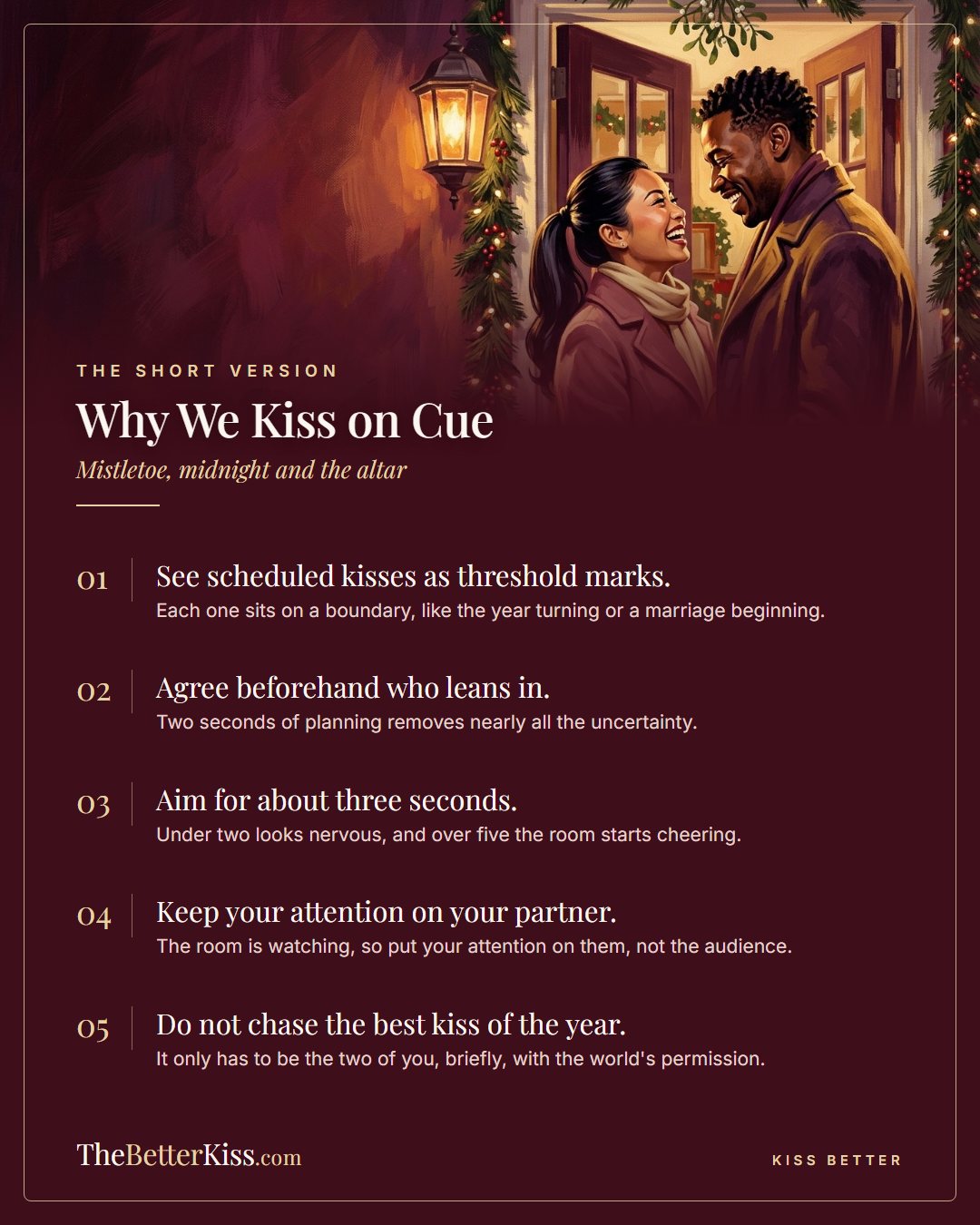
Thresholds. Every scheduled kiss sits on a boundary — the year turning, a marriage beginning, the liminal magic of midwinter greenery. Anthropologists have long noted that cultures mark boundary-crossings with binding gestures, and the kiss is the most human seal there is. The schedule isn't killing spontaneity; it's borrowing the kiss's meaning to consecrate a moment.
The short version of each
Mistletoe runs back through Norse myth (the plant tied to the god Baldr's death and his mother's tears-turned-berries) and druidic reverence for a plant that stays green in dead winter — a life-symbol under which enmity was suspended. The kissing custom itself flowered in English servant halls of the 18th–19th century, with a berry plucked per kiss. Midnight draws on old beliefs that how you enter the year sets its tone — enter it in affection, spend it in affection. The wedding kiss descends from the Roman legal kiss that sealed contracts: the couple's first married act is a seal, witnessed.
Surviving a kiss with an audience
Scheduled kisses carry performance pressure — the room is watching, and the spectator in your head pulls up a chair too. The fixes are practical: agree beforehand who leans and roughly how long (two seconds of planning removes nearly all the uncertainty); aim for about three seconds — under two looks nervous, over five and the room starts cheering; and put your attention on them, not the audience. A scheduled kiss doesn't have to be the best kiss of the year. It has to be the two of you, briefly, with the world's permission. That's rather the charm of it. If being watched is the part that frightens you, the spectator problem has a fix.
If the nerves are the real problem
Knowing how isn't the same as being able to in the moment. The first module of our guided course is free: no card, no account, about ten minutes.
Start module one, free