The Cheek Kiss: A Field Guide by Country
The cheek kiss is the most context-dependent gesture in the entire vocabulary: pure warmth in one country, over-familiar in the next, and a source of doorway confusion everywhere. Here's the field guide — and for the rest of the vocabulary, every kiss says something specific.
The count, by region
One: much of Latin America, the Philippines, and parts of the Middle East between friends. Two: France (usually — regional counts famously vary from one to four), Spain, Italy, Portugal, and much of the Arab world among the same gender. Three: the Netherlands, Belgium, Switzerland, Russia among close friends, Egypt in many circles. None at all: most of East Asia, where bows and nods carry the same warmth, and business settings almost everywhere.
Which side first?
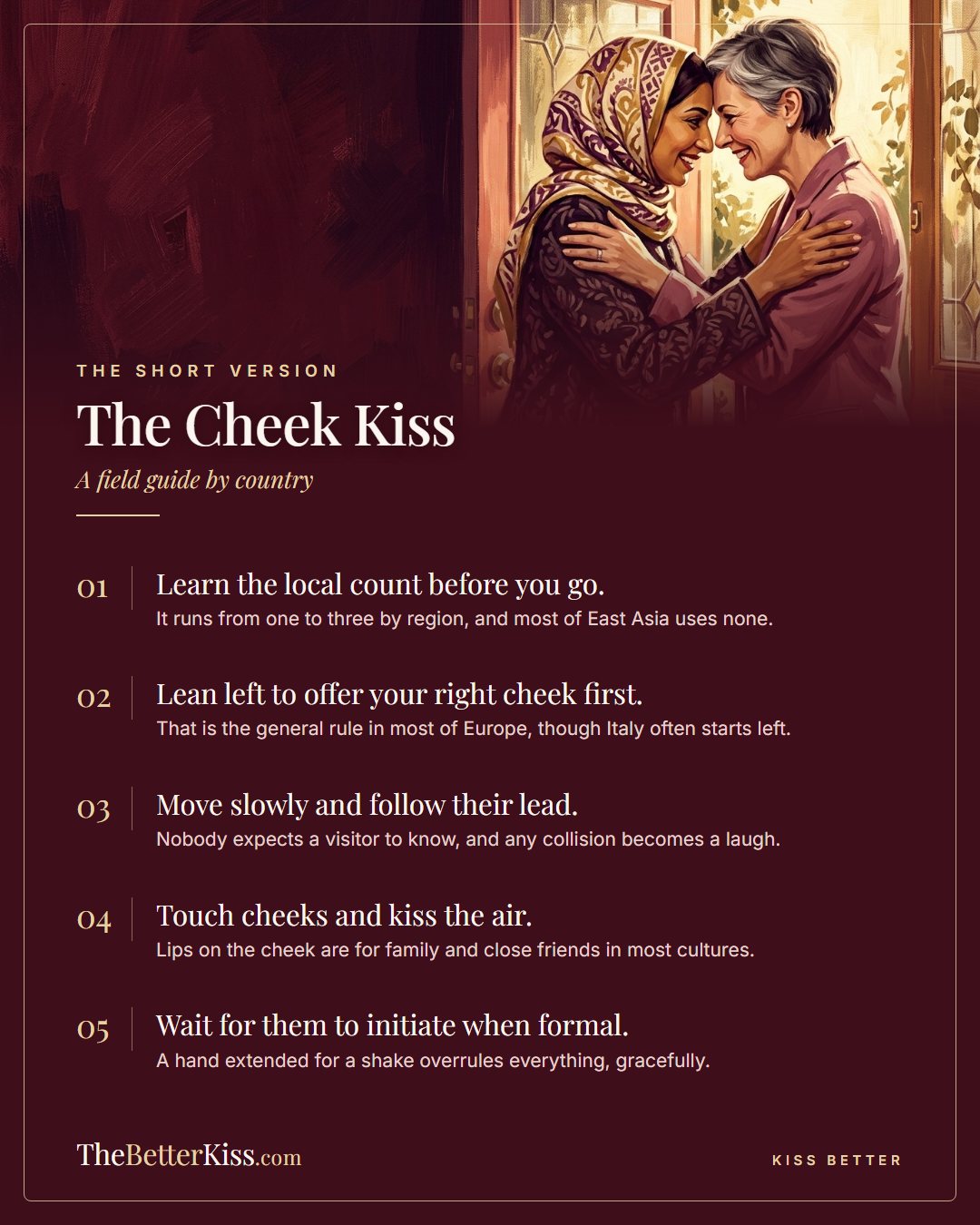
Generally right cheek first (lean left) in most of Europe and Latin America — but Italy often starts left. The honest answer: nobody expects a visitor to know. Move slowly, follow their lead, and any collision becomes a laugh, which is itself a fine greeting.
The universal rules
It's usually a cheek touch with a kiss to the air, not lips to skin — lips-on-cheek is for family and close friends in most cultures. Hands go to shoulders or upper arms, or nowhere. And status matters: in formal or first-meeting contexts, wait for the other person to initiate; a hand extended for a shake overrules everything, gracefully.
What it says everywhere
Underneath the choreography, the message is constant: you're inside the circle of warmth, within the rules. The rules are the point — the cheek kiss is affection made socially safe, which is why it survives in cultures that keep every other kiss private. Learn the local count, lean slowly, and you're fluent. And if you're trying to read what a particular cheek kiss means — greeting, affection, or the start of something — that's decoded here. That variation isn't modern, either: kissing customs have differed wildly for 4,500 years.
If the nerves are the real problem
Knowing how isn't the same as being able to in the moment. The first module of our guided course is free: no card, no account, about ten minutes.
Start module one, free