What Does a Kiss on the Cheek Mean? Reading the Context
The cheek kiss is the great ambiguity of the kissing world. The identical gesture — lips or near-lips to a cheek — can mean pure friendship, cultural politeness, tender affection, a gentle let-down, or the first tentative step toward something more. Meaning lives entirely in the context. Here's how to read it.
On this page
The greeting cheek kiss
The most common and the least loaded. In much of Europe, Latin America, and the Middle East it's simply how people say hello — warm, expected, and no more romantic than a handshake. The tells: it's quick, it's often air-to-cheek rather than lips-to-skin, hands stay on shoulders or nowhere, and it happens at the start or end of an encounter as ritual rather than impulse. The full country-by-country field guide is here.
The affectionate cheek kiss
Slower, softer, lips actually meeting skin, often with a hand on the arm or back. This is family and close-friend territory — it says I'm fond of you without saying anything romantic. Context decides: from a grandparent it's love; from a date it's warmth that may or may not be going somewhere.
The romantic-tentative cheek kiss
On a date, a cheek kiss that lingers half a second too long, or lands very close to the corner of the mouth, is often a test balloon — interest checking whether it's welcome before risking the lips. The signal isn't the cheek kiss itself; it's the held beat afterward and where their eyes go. If they linger and hold your gaze, you're being asked a question. Here's how to read and answer it.
The let-down cheek kiss
At the end of a date, a brisk cheek kiss offered when a lip kiss was possible is usually a kind no — warmth without escalation, closing the evening gently. It's not rejection of you as a person; it's a clear, considerate answer to a specific question. Received gracefully, it keeps a friendship intact and sometimes leaves a door ajar.
How to actually tell them apart
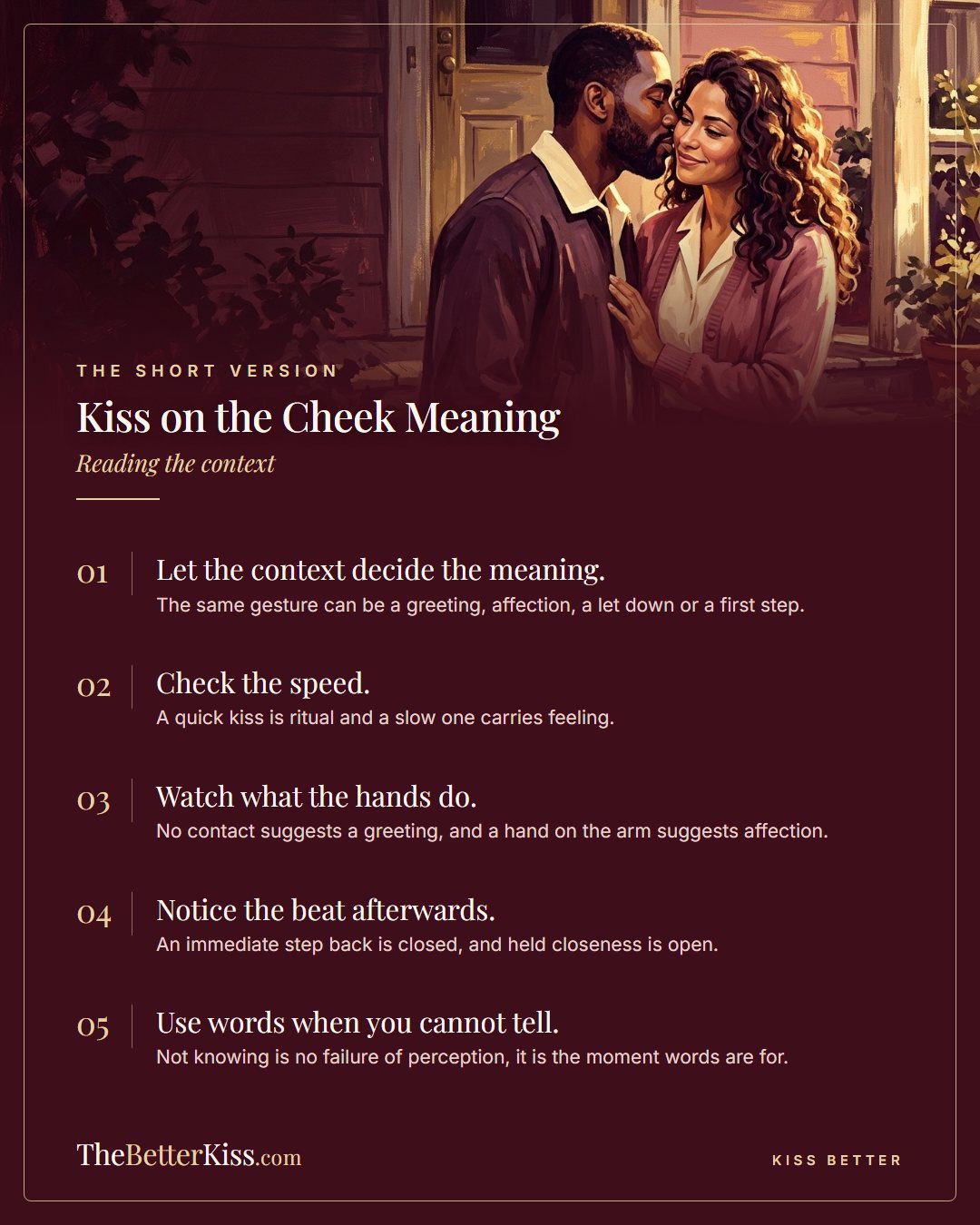
Three things decode almost every cheek kiss: speed (quick = ritual, slow = feeling), what the hands do (nothing = greeting, contact = affection), and the beat afterward (immediate step back = closed, held closeness = open). Read those three and the ambiguity mostly resolves. And when it doesn't — when you genuinely can't tell — that's not a failure of perception. That's the moment words are for.
If the nerves are the real problem
Knowing how isn't the same as being able to in the moment. The first module of our guided course is free: no card, no account, about ten minutes.
Start module one, free