First-Kiss Nerves: Why They Happen and What Actually Helps
Search “how to kiss” at 1am and you'll find ten thousand articles about lips. If you're reading this one, you already suspect what we know for certain: the lips were never the problem (the technique guide is there when you want it, and it will still be there afterwards). You can watch a technique video in ninety seconds. If information were the answer, you'd have solved this years ago.
On this page
The real mechanism has a name
In 1970, the researchers Masters and Johnson described something they called spectatoring: mentally stepping outside yourself during an intimate moment to watch and grade your own performance. Instead of being in the experience, you're above it, running commentary — am I doing this right, what do I look like, is my hand in a weird place.
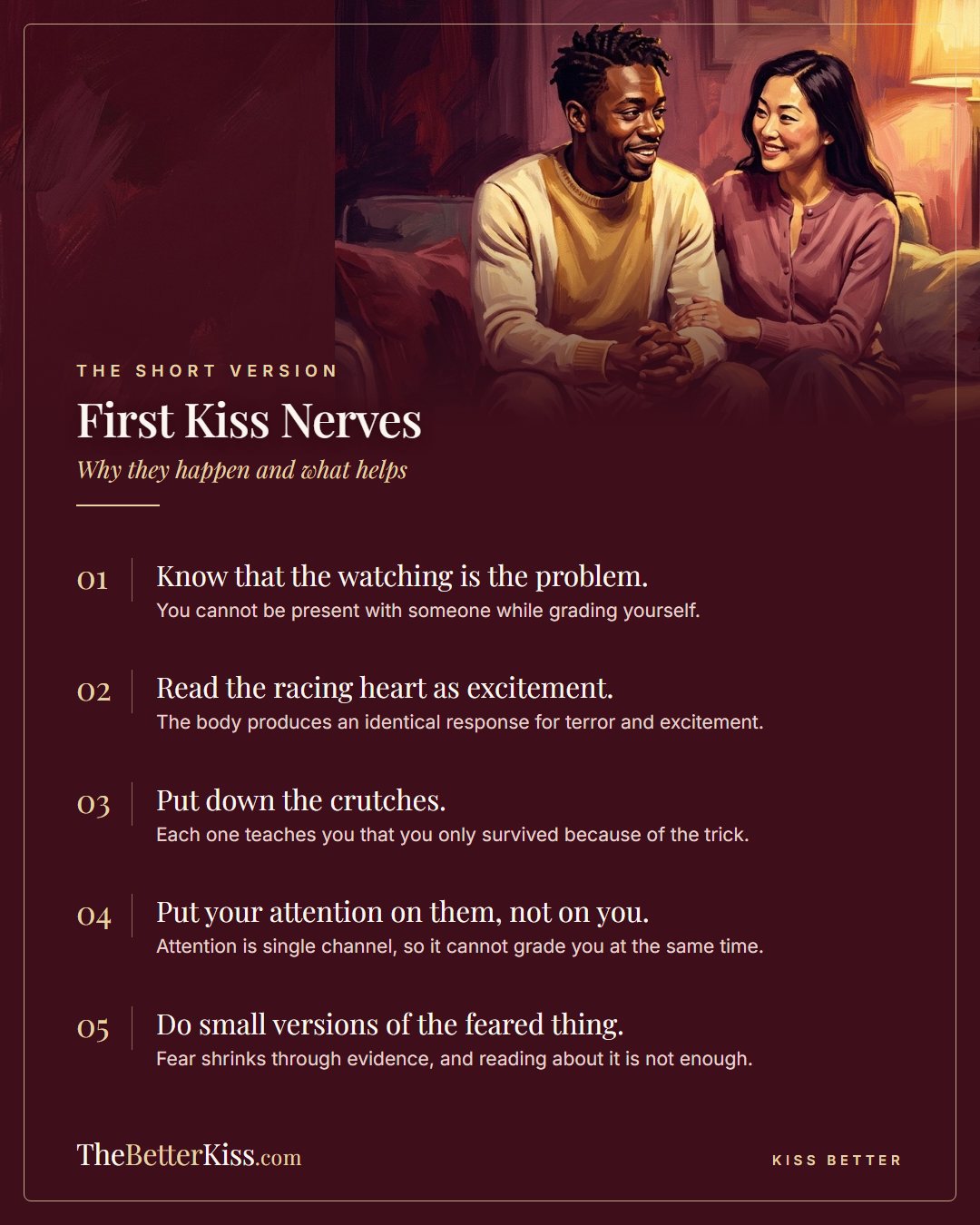
The cruel part: the monitoring itself produces the failure it's trying to prevent. You cannot be present with someone while grading yourself from the ceiling. The watching isn't a side effect of the problem. The watching is the problem.
Three places the fear does its work
Kiss anxiety isn't one event — it's three, and they need different handling.
Before: the hours spent running simulations. What if they turn away, what if I freeze, what if I lean the wrong way. It feels like preparation; it's rehearsal of the fear. Every run-through makes the imagined disaster more vivid, so by the time the real moment arrives you've lived fifty bad versions and none of the good ones.
During: the spectator, watching from the ceiling.
After: the replay at 2am — isolating the worst two seconds and playing them on loop. This is where the real damage happens, because a neutral event gets converted into evidence against you. The replay isn't an accurate recording: anxiety edits it, keeping every awkward frame and deleting the parts where the other person was smiling. That distorted cut becomes the memory. It's how one mediocre kiss sets someone back a year.
Your body is not malfunctioning
The racing heart, the dry mouth, the shaky hands: that's adrenaline, and here's the fact that changes everything — your body produces an identical response for terror and for excitement. Same chemical, same symptoms. The only difference is the label your mind attaches. You've been reading those sensations as evidence something is wrong. They're what wanting something feels like when the stakes feel high.
And they're far less visible than they feel. Psychologists call it the illusion of transparency: we consistently overestimate how much of our internal state shows. The pounding heart is private. The audience for your nervousness is almost entirely internal.
The tricks that keep the fear alive
Here's the most counter-intuitive thing in this entire subject. Everyone anxious about kissing accumulates crutches: two drinks first, a rehearsed opening line, low lighting, only ever kissing someone who initiated. They feel like sensible preparation. They are the single biggest reason the anxiety persists.
The mechanism is precise. Every time you get through a frightening moment with the crutch, your mind draws the wrong conclusion — I survived because I had the trick — and the belief that you couldn't have survived without it stays completely intact. You never collect the one piece of evidence that would actually free you: that you can handle this as yourself. Clinicians call these safety behaviours, and dropping them is a core part of how social anxiety is actually treated.
What "just relax" gets wrong
You cannot relax on command — relaxation is an outcome, not an action, and being told to produce it usually adds a second failure to monitor. Same with "be confident." The instruction that works is concrete because it's a thing you can do: put your attention on them, not on you. What does their skin feel like. Are they leaning in. What's their breathing doing.
It works for a mechanical reason. Attention is single-channel. Occupied with someone else, it cannot simultaneously grade you. You're not suppressing the spectator; you're giving its seat away.
Why understanding this isn't enough
Here's the part self-help articles won't tell you, because it ends the article: reading about a fear doesn't shrink it. Fear shrinks through evidence, and evidence comes from doing small versions of the feared thing and surviving them — the same principle clinicians use to treat social anxiety. The loop that keeps you stuck — shame, avoidance, no evidence, fear at full size — opens from the doing end, never the reading end.
That's exactly why we built our course the way we did: not another technique list, but a guided path through the fear itself — with the first module free, because you shouldn't have to pay to find out whether we understand you. Start at the confidence hub for the reading order, or go straight to the technique that removes most of the risk.
If the nerves are the real problem
Knowing how isn't the same as being able to in the moment. The first module of our guided course is free: no card, no account, about ten minutes.
Start module one, free