How to French Kiss (Without Overthinking It)
No kiss carries more myth than this one, and no kiss is ruined more often by trying too hard. So let's start with the sentence that fixes most French kissing on its own (and if you want the fundamentals first, start with the honest guide): tongue is a seasoning, not a main course.
On this page
- First, the name
- Earn the door first
- Less, slower, softer
- The conversation rule still governs
- The rhythm, in phrases
- A first French kiss, step by step
- The five usual mistakes, and the fix for each
- What to do with your hands and the rest of you
- When to stop, and how
- Questions people actually ask
- Housekeeping, honestly
First, the name
The French have never called it this. “French kiss” entered English in the early 1920s, carried home by soldiers who had decided the French were simply better at the whole business. So the term is a compliment paid by people who were slightly intimidated — which is roughly how most of us still feel about it. Good news: it's far less complicated than its reputation.
Earn the door first
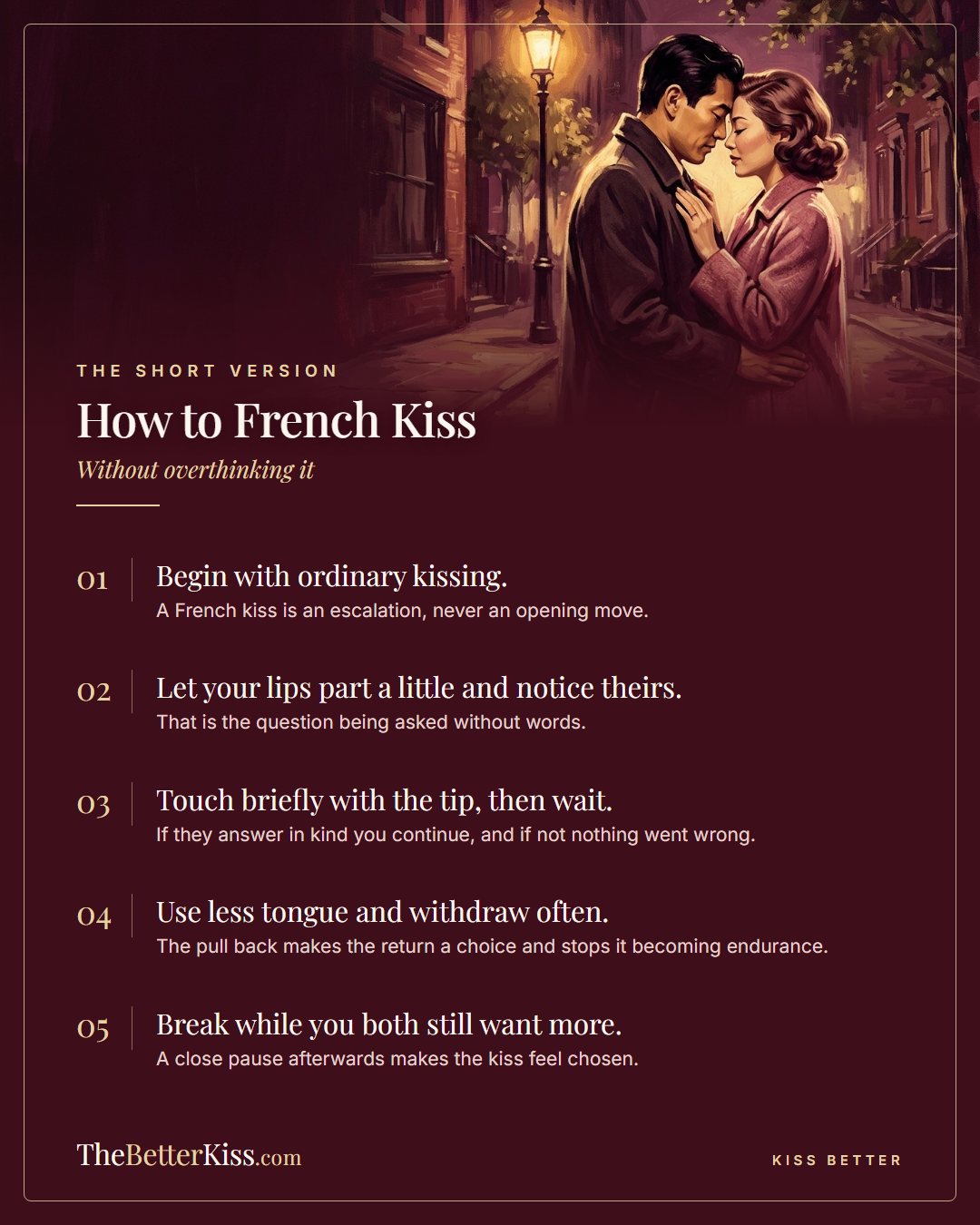
A French kiss is not an opening move — it's an escalation, and escalations are invitations accepted, not launched. Start with ordinary kissing. When it deepens on its own — lips parting slightly, breath changing — that's the door opening. The tip of your tongue, briefly, against their lip. Then wait. If they answer in kind, you're in a French kiss. If they don't, you're still in a lovely ordinary one, and nothing whatsoever went wrong.
Less, slower, softer
Everything you do will feel one-third bolder to them than it does to you. So: brief touches, not exploration. Movement, not writhing. Retreat often — the pull-back is half the pleasure, because it makes the return a choice. The classic beginner error is continuous maximum tongue; the fix is thinking in phrases: a touch, a response, a withdrawal, a smile against their mouth.
The conversation rule still governs
As with all kissing, the loop is match-then-vary: meet their intensity, then change one small thing. If their tongue is shy, yours should be. If they surge, you can meet it — briefly — then slow it, which reads as confidence more than matching speed ever does. The person who sets a slower pace almost always reads as the better kisser.
The rhythm, in phrases
Think of it as sentences rather than a continuous stream. A brief touch. Their answer. A withdrawal. A pause with your foreheads close. Then again, slightly different — a fraction slower, a fraction softer. That structure is why some people are described as extraordinary kissers without doing anything technically unusual: they punctuate. Continuous maximum intensity is the beginner signature, and it reads as urgency rather than desire.
A first French kiss, step by step
- Kiss normally first. Closed-mouth, soft, unhurried. Thirty seconds of this is not a delay; it's the foundation.
- Let your lips part a little. Not a gape — a few millimetres. Notice whether theirs do too. That's the question being asked without words.
- One brief touch. The tip of your tongue against their lower lip or the tip of theirs. Half a second. Then withdraw.
- Read the answer. If they meet you, continue. If they stay closed-mouth, stay there with them and enjoy the kiss you're actually having.
- Keep it shallow. Tip to tip, slow, with breaks. Depth is not the goal and never was.
- Come up for air together. Pause, foreheads close, breathe, smile. Then decide — both of you — whether there's a second verse.
If you'd rather ask out loud at step two, ask. “Can I kiss you properly?” said quietly and close is not unromantic. Done warmly, it's the most attractive thing on this list. If the asking is the part that frightens you, here's how to read the moment and how to ask well.
The five usual mistakes, and the fix for each
Too much tongue. The classic. Fix: use a third of what you think you need, and withdraw twice as often.
Too fast. Speed reads as nerves. Fix: deliberately kiss at half your instinctive pace. Slow is what confidence looks like from the other side.
The rigid tongue. A tense, pointed tongue feels like being prodded. Fix: soften your jaw first; the tongue follows the jaw.
No breaks. A French kiss with no punctuation becomes an endurance event. Fix: pull back every few seconds, even by a centimetre.
Forgetting the other person. Running a routine instead of responding. Fix: the one skill that makes someone a good kisser is attention, and it applies here more than anywhere.
What to do with your hands and the rest of you
A French kiss with hands hanging uselessly is a strange, disembodied thing. One hand placed deliberately — the jaw, the side of the neck, the small of the back — anchors everything and communicates far more than the tongue does. The other can stay still. Placed beats hovering, every time.
When to stop, and how
Break it while you both still want more, not when it runs out of steam. Stay close for a beat afterwards — the forehead-to-forehead pause with a slow exhale is the single most underrated move in kissing, because it makes the whole thing feel chosen rather than merely completed. Then say something warm and ordinary. That two-second aftermath is where the memory of the kiss actually gets written.
Questions people actually ask
How long should a French kiss last? Shorter than you fear. A few seconds of tongue inside a longer kiss is plenty. A kiss that feels too long is nearly always too same, so vary it or break it rather than timing it.
What if they use far too much tongue? Slow down and pull back slightly; most people match the pace they're given within a few seconds. If they don't, say it kindly: “Slower — I like it slower.” That sentence has improved more kissing than any guide.
What if I've never done it? Then you have no bad habits to unlearn. Everything above works on a first attempt, and nobody can tell a careful beginner from a considerate expert. If the nerves are louder than the instructions, start with why they happen.
Is it unhygienic? Researchers measured this: a ten-second intimate kiss transfers around 80 million bacteria (Kort et al., 2014, Microbiome). That sounds alarming and isn't — couples who kiss often simply end up with more similar mouth bacteria. Skip it when either of you is ill or has a cold sore. Otherwise, carry on.
Do I have to? No. Plenty of people prefer closed-mouth kissing, and plenty of long, happy relationships run on it. A French kiss is an option on the menu, not the measure of a kisser.
And when one kiss turns into a long run of them, that has its own guide: how to make out.
One standing rule, here as everywhere on this site: none of this is a method for turning a no into a yes. A kiss that isn't wanted isn't a kiss worth having, and asking twice is pressure, not persistence.
Housekeeping, honestly
Swallow before, not during. Breathe through your nose. Mind your teeth — they're scaffolding, not participants. And if it goes clumsy for a second (it will, for everyone): pull back a centimetre, smile, resume. Shared amusement resets everything, and it always has.
If the nerves are the real problem
Knowing how isn't the same as being able to in the moment. The first module of our guided course is free: no card, no account, about ten minutes.
Start module one, free