Why Does Kissing Feel Good? The Short, Honest Science

A kiss is skin touching skin — the same material as a handshake — and yet the experience is categorically different. Here's why, in the actual mechanisms — and for the longer-term effects, what kissing does to your body. (For the psychological reasons it feels meaningful, see why people enjoy kissing.)
The hardware: absurdly overrepresented lips
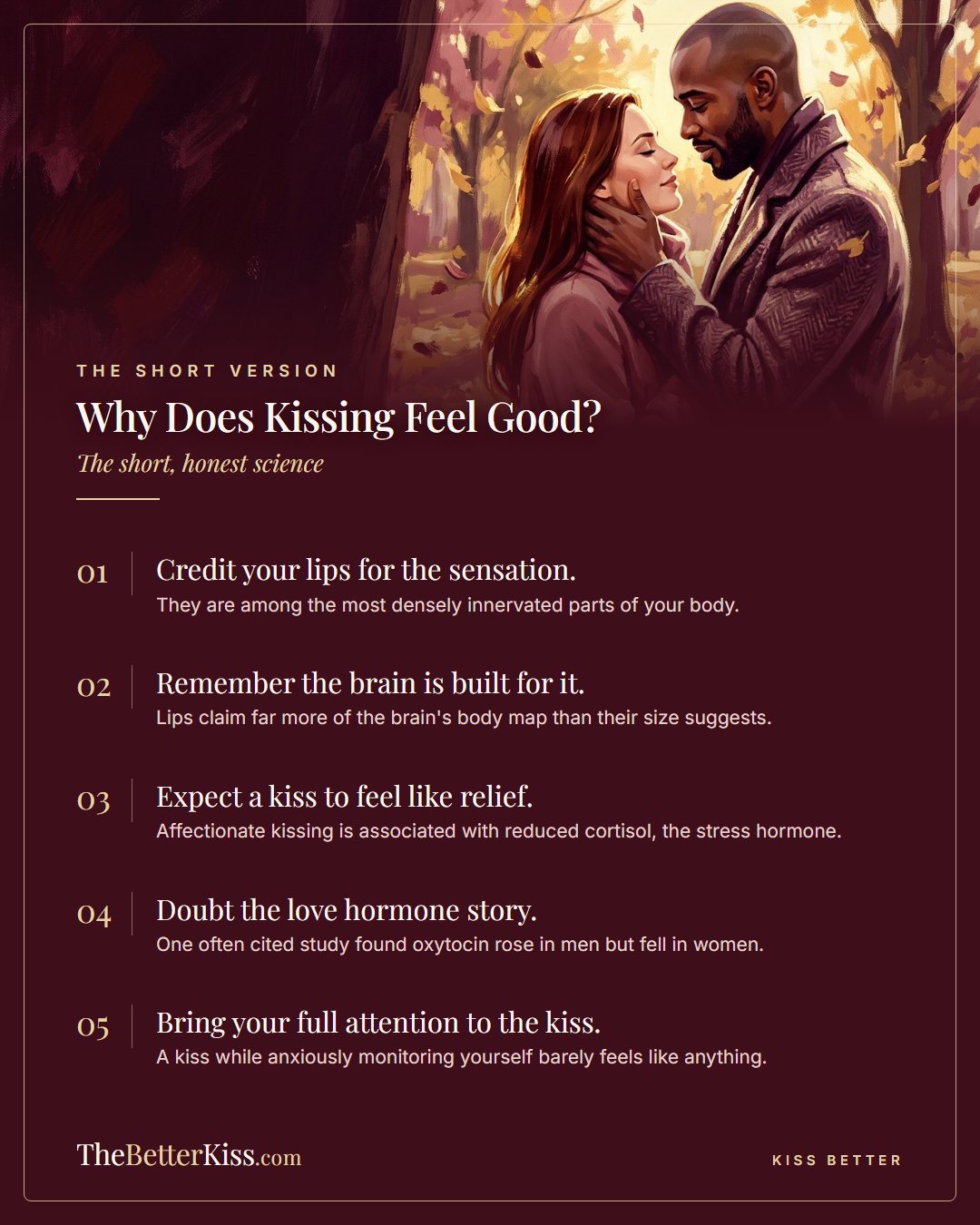
Your lips are among the most densely innervated parts of your body, packed with receptors for light touch, temperature, and pressure. And the brain matches the investment: in the somatosensory cortex — the brain's map of the body — the lips claim real estate wildly out of proportion to their size. A kiss delivers an enormous amount of high-resolution sensory data to a brain built to savour exactly that.
The chemistry, told honestly
(And no, it isn't meaningful exercise — we checked the calorie claims.) Kissing engages the brain's reward circuitry — dopamine-linked wanting is part of why a good kiss feels like an event rather than a sensation. Stress physiology moves too: affectionate kissing is associated with reduced cortisol, the stress hormone, which matches the felt sense of a kiss as relief.
The software: attention
The final ingredient isn't in the lips at all. A kiss commandeers attention — eyes close (your brain literally dims vision to feel touch better), the world narrows to warmth and breath and the other person. That absorption is a large part of the pleasure, which explains the unhappy converse: a kiss experienced while anxiously monitoring yourself barely feels like anything. The sensation was always there. The attention wasn't — which is exactly what kiss anxiety does. (It's also why your eyes close by themselves.)
If the nerves are the real problem
Knowing how isn't the same as being able to in the moment. The first module of our guided course is free: no card, no account, about ten minutes.
Start module one, free