How to Get Rid of a Hickey: What Works, What Doesn't
You can't get rid of a hickey quickly. It is a bruise, and nothing sold or shared online removes a bruise overnight, let alone in minutes. What you can do is avoid making it worse, possibly shave a little off the healing time, and cover it properly while your body does the work.
On this page
- Can you get rid of a hickey overnight?
- Does ice or a cold spoon help a hickey?
- Does heat help with hickeys?
- Does arnica work on a hickey?
- Does vitamin K cream work?
- Does toothpaste get rid of a hickey?
- The coin, the toothbrush and the lipstick cap
- Banana peel, aloe and the rest of the kitchen
- What about laser removal?
- So what should you actually do?
- When to see a doctor
- Quick answers
Not the answer anyone wants at 7am with a mirror and a meeting. Here is every remedy people search for, and what the evidence for each actually is. The basics are in our main hickey guide.
Can you get rid of a hickey overnight?
No. A dermatologist interviewed by Cleveland Clinic puts it plainly: hickeys, like other bruises, need time to heal, and you are unlikely to shift one overnight or in a few hours. The same doctor describes a hickey as a stain in the dermis, the second layer of the skin. Nothing you rub on the surface reaches it, and the leaked blood has to be broken down and carried off by your own cells. The colour changes are that process happening.
"In five minutes", "instantly" and "by morning" all get the same answer. For the realistic timeline, see how long a hickey lasts.
Does ice or a cold spoon help a hickey?
A little, and only early. For ordinary bruises, the standard advice is ice packs during the first 24 to 48 hours, wrapped in a towel, for no more than 15 minutes at a time. MedlinePlus adds that you should never put ice directly on the skin.
For a hickey specifically, the Cleveland Clinic dermatologist is less keen: cold is only worth trying in the first few minutes, and even then offers minimal relief, because the injury is so slight. The evidence for ice in general is weaker than its reputation. A systematic review of 22 randomised trials of ice for soft-tissue injuries found few studies of closed injuries like bruises and no evidence for a best method or duration.
The cold spoon is just a small, awkward cold compress, and by the next morning the window for cold has mostly closed.
Does heat help with hickeys?
This is the remedy doctors actually recommend. For bruises in general, the advice is a warm compress or heating pad after the first two days. For hickeys, the Cleveland Clinic dermatologist suggests starting warm compresses straight away, on the reasoning that warmth opens the blood vessels and helps carry away the red blood cells that have spilled into the skin. His method: a clean cloth soaked in water that is warmer than a bath but nowhere near boiling, held on until it cools, repeated for 15 to 20 minutes, up to four times a day.
This is expert advice built on sensible physiology. We could not find a trial that measured how much faster a bruise fades with heat. Expect a modest nudge, not a rescue.
Does arnica work on a hickey?
Maybe slightly. Nobody has tested arnica on hickeys, so the best evidence comes from small trials on bruises made deliberately with a laser.
- In one trial, healthy volunteers were given four identical laser bruises and a different ointment for each. After two weeks, the bruise treated with 20% arnica had improved more than the one treated with plain petrolatum.
- An earlier placebo-controlled trial in 19 people found no significant difference between arnica gel and the gel base alone.
- A 2016 systematic review of arnica around skin procedures found mixed results and concluded there is insufficient data to support its use. Most of those trials were of arnica tablets, not cream.
So: one positive trial with a strong ointment, one negative trial, and a review that shrugs. Use it on unbroken skin if you like. Cleveland Clinic advises you to avoid arnica if you take blood thinners.
Does vitamin K cream work?
Similar story, slightly better numbers. In a double-blind trial of 22 people having laser treatment on the face, vitamin K cream applied afterwards reduced the severity of bruising compared with placebo, mainly in the first few days. Applying it beforehand prevented nothing. A second study of 20 adults found that a cream combining 1% vitamin K with retinol cleared laser bruises faster than no cream, although several other vitamin K formulas in the same study did not earn that conclusion. A third, of a vitamin K oxide gel, saw a trend towards faster clearing that did not reach statistical significance.
These are tiny studies, on laser bruises, with creams applied twice a day for one to two weeks. "Reduced severity" means somewhat better on a rating scale, not gone by Friday. No cream, patch or tablet sold as a "hickey remover" has better evidence than this.
Does toothpaste get rid of a hickey?
No. Toothpaste tingles, which feels like progress and isn't. Cleveland Clinic's dermatologist says scrubbing with toothpaste is too superficial to affect the hickey, and irritating the skin can leave the area looking worse.
The coin, the toothbrush and the lipstick cap
These are the tricks to avoid. The idea is to "break up" the blood by scraping a coin edge across the skin, scrubbing with a toothbrush or twisting a cap into the mark. What you are really doing is injuring already injured skin. The same dermatologist warns that abrasive treatment can cause scratches, bleeding, additional discolouration and scarring.
There is also direct evidence of what coin-scraping does to skin, because it is a traditional therapy in several Asian countries. A dermatology case report notes that people who have had it frequently present with redness, pinpoint bleeds and raised bruises where the coin went. The coin trick is a reliable way to make a bruise, which makes it a strange choice for removing one.
Banana peel, aloe and the rest of the kitchen
We searched the medical literature for banana peel and bruising and found no studies at all. Aloe is at least a real skin treatment, but Cleveland Clinic's dermatologist says it is not much help on hickeys, since there is little inflammation to calm. Vaseline has, in a sense, been tested: plain petrolatum was the comparison ointment in the arnica trial above, and it lost.
What about laser removal?
It exists. Dermatologists can treat bruises with a pulsed-dye laser, and in one study of 20 people bruised after facial cosmetic procedures it produced a 63% average improvement within 48 to 72 hours. Cleveland Clinic mentions it as an option in the first 24 to 48 hours, while noting it is expensive and still takes a day or two. For a wedding, perhaps.
So what should you actually do?
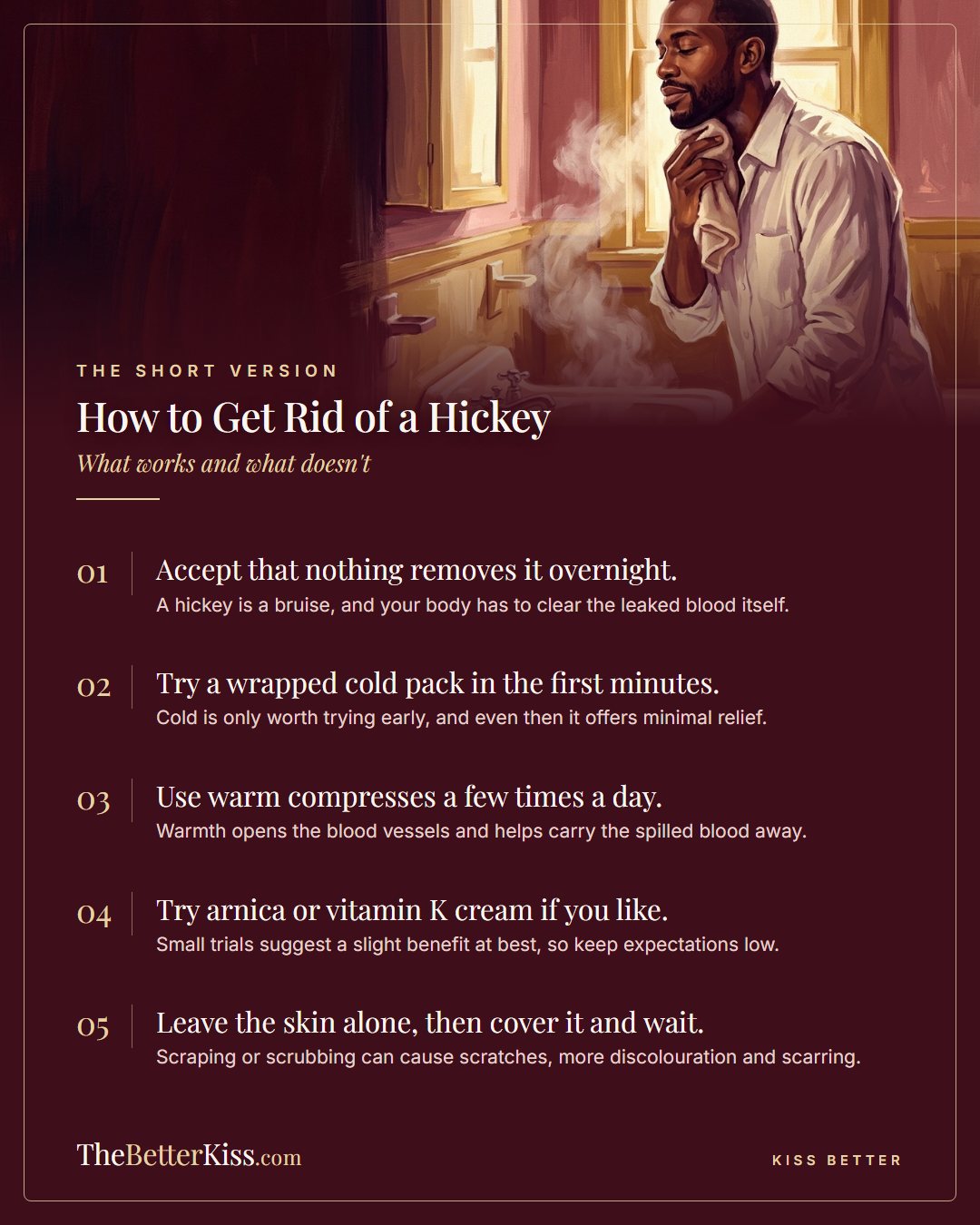
- In the first minutes, a wrapped cold pack if you have one.
- From then on, warm compresses a few times a day.
- Arnica or vitamin K cream if you like, twice a day, with low expectations.
- Leave the skin alone. No scraping, scrubbing or hard massage.
- Cover it, and wait.
When to see a doctor
A hickey almost never needs one. Do get checked if you have a bruise that lasts more than two weeks, a lump in the bruised area, or bruises that are frequent, large or unexplained. See someone promptly if scraped or bitten skin shows signs of infection such as spreading redness, pus or fever. For the rarer risks, read are hickeys dangerous?

Quick answers
Does massaging a hickey help? We found no trials showing that it does. A bruise is damaged blood vessels, so go gently if you do it at all.
Do hickeys get worse overnight? They can look worse. A bruise typically starts pinkish red and then turns bluish, so a darker mark the next morning is normal.
How do you get rid of a hickey on the lip or face? The same way, but more gently. Skip the creams near your mouth and eyes and stick to warm compresses.
How do I stop this happening again? Say "no marks" before things get going. Your neck, your decision.
This is general information, not medical advice. If you are worried about a symptom, speak to a doctor, dentist or pharmacist.
- Cleveland Clinic, "How To Get Rid of Your Hickey, Fast" (2024)
- Cleveland Clinic, "Bruises (Ecchymosis)" (2023)
- MedlinePlus, US National Library of Medicine, "Bruise" (2025)
- American Journal of Sports Medicine, "The use of ice in the treatment of acute soft-tissue injury: a systematic review of randomized controlled trials" (2004)
- British Journal of Dermatology, "Accelerated resolution of laser-induced bruising with topical 20% arnica: a rater-blinded randomized controlled trial" (2010)
- Dermatologic Surgery, "Effects of topical arnica gel on post-laser treatment bruises" (2002)
- Dermatologic Surgery, "Is There a Role for Arnica and Bromelain in Prevention of Post-Procedure Ecchymosis or Edema? A Systematic Review of the Literature" (2016)
- Journal of the American Academy of Dermatology, "The effects of topical vitamin K on bruising after laser treatment" (2002)
- Dermatologic Surgery, "Effects of topical vitamin K and retinol on laser-induced purpura on nonlesional skin" (1999)
- Journal of Drugs in Dermatology, "The role of topical vitamin K oxide gel in the resolution of postprocedural purpura" (2009)
- Cureus, "New Onset of Linear Purpura on the Back: Coining Therapy-Associated Ecchymoses" (2020)
- Archives of Facial Plastic Surgery, "Pulsed-dye laser for treating ecchymoses after facial cosmetic procedures" (2009)
If the nerves are the real problem
Knowing how isn't the same as being able to in the moment. The first module of our guided course is free: no card, no account, about ten minutes.
Start module one, free