How to Give a Hickey (and When Not To)

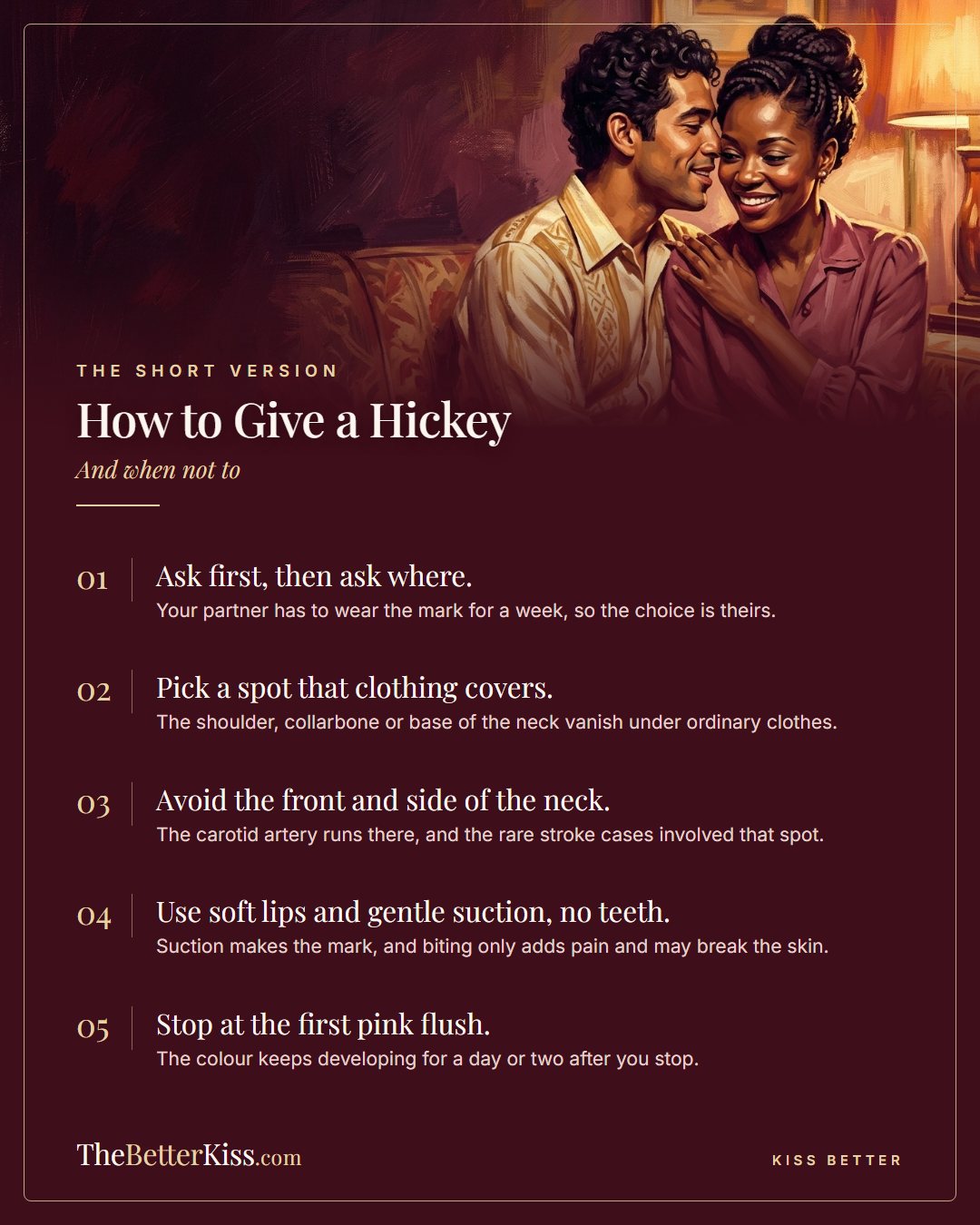
To give a hickey, you ask first, pick a spot that clothing covers, seal your lips softly against the skin and apply gentle suction for a few seconds at a time, checking as you go. That is the whole technique. The skill is in the asking, the placing and the stopping early, because a hickey is the one kiss the other person has to wear for a week.
On this page
What you are actually doing
You are making a bruise. A hickey is a bruise caused by trauma to the skin, such as by sucking or biting: suction breaks tiny blood vessels under the surface and the blood they release collects into a dark spot. That tells you three things. More suction means a bigger bruise. It cannot be undone. And it works the same way on every adult, so there is no separate method for a man or a woman.
Ask first
“Can I leave a mark?” is the first step, not an optional extra. The follow-up is “where?”. Your partner knows whether they have a meeting on Monday, a family lunch or a job where a marked neck is a problem, and you don't. A yes last month is not a yes tonight, and “not where anyone can see” is a normal answer. If they say no, kiss them properly instead; a good make-out does not need a souvenir.
Where can you give hickeys?
Anywhere the skin is soft and fairly thin, which is why the neck is the classic spot. Since you can get them anywhere, the better question is where your partner would like one.
Kinder places: the top of the shoulder, the collarbone, the base of the neck where a collar sits, the upper chest, the upper arm, the inner thigh. All of them disappear under ordinary clothes.
Places to think twice about: the face, the lips and anywhere above a shirt collar. These cannot be hidden without make-up, and hiding one is a daily chore for as long as it lasts.
The place to avoid: the front and side of the neck below the jaw. The carotid artery runs there, and the two published cases of a stroke after a love bite both involved a mark in that spot. In the best known, from New Zealand, doctors found a clot in the carotid artery beneath a love bite on a woman's neck. This is extremely rare, and our article on hickey risks goes through both cases, but the precaution costs you nothing. WebMD's advice is the same: try not to give or receive a hickey close to the carotid artery. Go lower and further back, towards the shoulder.
How to give a hickey, step by step
- Start with ordinary kissing. Soft, moving kisses on the area first.
- Make a small seal. Part your lips into a soft oval about the size of a large coin and rest them on the skin. Lips only. Keep your teeth behind them.
- Apply gentle suction. Draw the skin in slightly, as if sipping through a straw, and hold for three to five seconds.
- Stop and look. Lift off and check. A pink flush means the mark has started.
- Repeat only if you both want more. Another few seconds at a time. Ask how it feels. It should be a pulling sensation, not pain.
- Finish gently. A light kiss over the spot, then move on.
There is no medical guidance on how many seconds a hickey takes, so treat the numbers above as a cautious starting point, not a rule. Skin varies a great deal. People who take aspirin or other blood-thinning medicine are likely to bruise more easily, and some people simply mark at a touch.
How to give a light hickey, or a small one
Do less than you think you need. The colour carries on developing after you stop: redness appears on the first day and the bruise turns bluish-purple or darker over the next day or two. What looks faint tonight can look emphatic tomorrow. For a small mark, make the seal smaller. For a light one, use less suction and stop at the first flush.
The searches for a dark, big or long-lasting hickey all have the same answer: more suction for longer makes a deeper bruise, which is darker, sorer and slower to clear. That is a bigger decision about someone else's week, so it needs a clearer yes. Nothing makes a hickey permanent, and you should not want it to; they fade in days to a couple of weeks.
How to give a hickey without teeth, and without it hurting
You do not need teeth at all. The mark comes from suction, and biting only adds pain and the chance of breaking the skin, at which point it is a wound and not a hickey. Keep your lips soft, keep the suction steady instead of sharp, and check in. A hickey given well is mildly tender afterwards at most. If your partner flinches, stop.
Braces are no obstacle, since your lips do the work. Just keep the brackets off their skin.
How to give yourself a hickey
You can, on the places your own mouth reaches: the forearm, the upper arm, the back of the hand. The method is identical. People also use a bottle, a cup or a pinch of the fingers to create suction on the neck, and the honest answer is that these do work, because any suction strong enough bruises skin. They are also harder to control than a mouth, so the result is often larger and darker than intended. If you try it, keep it off the side of the throat for the reason above. A dab of make-up gives the look without the week.
How to kiss the neck without leaving a hickey
Keep moving and do not suck. A hickey needs suction held on one spot, so soft lips that travel will not leave one. Kiss lightly, change place every second or two, and stay lighter still if your partner bruises easily. WebMD's prevention advice is plain communication: if your partner spends too much time on one area, suggest another spot. There is more on this kind of kiss in what a neck kiss means.
Quick answers
Do hickeys appear immediately? A red or pink patch usually shows within minutes, and it darkens over the following day or two. The first part is common experience, not something we found measured.
Can you get a hickey from just kissing? Not from ordinary kissing. It takes suction or biting held in one place.
What should you do right after getting one? Leave it alone. Our removal guide covers what helps and what makes it worse.
Can you give a hickey on the lips or face? Yes, the skin bruises there too, and it is the hardest place to hide. Most people would thank you not to.
I gave one by accident. What now? Apologise, offer the concealer, and next time keep your lips moving. The basics are in our main hickey guide.
If the nerves are the real problem
Knowing how isn't the same as being able to in the moment. The first module of our guided course is free: no card, no account, about ten minutes.
Start module one, free