Hickey Stages: The Colours Day by Day

A hickey goes through the same colours as any bruise: red or pink at first, then purple or blue, then greenish, then yellow or light brown, then gone. Each colour is a different point in your body's breakdown of the blood that leaked into the skin, which is why a hickey turning yellow is good news. It means the clean-up is nearly finished.
On this page
- What are the stages of a hickey?
- Why are hickeys red, then purple?
- Why do hickeys turn green?
- Why do hickeys turn yellow?
- What is the brownish stage at the end?
- What does a hickey look like on dark skin?
- Is a hickey a bruise? Hickey vs bruise
- Hickey or rash? Hickey vs bite, burn and scratch
- When to see a doctor
- Quick answers
What are the stages of a hickey?
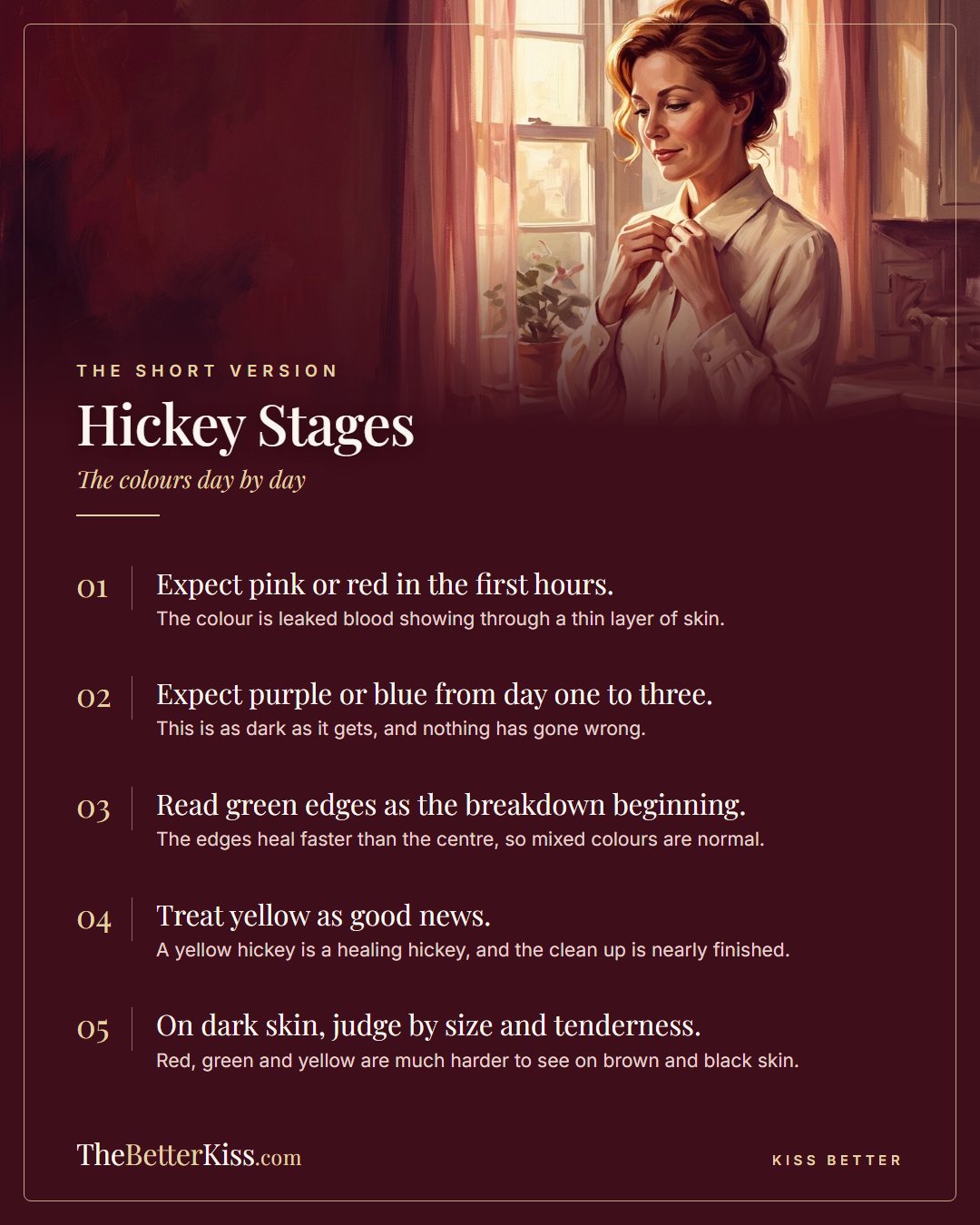
MedlinePlus, the US National Library of Medicine's patient site, describes the sequence for bruises in general: the mark begins pinkish red, changes to a bluish colour, then greenish-yellow, and finally returns to normal skin colour. For a typical hickey on lighter skin, that plays out roughly as follows:
- Stage 1, the first hours: pink or red.
- Stage 2, days one to three: dark red, purple or blue. This is as dark as it gets.
- Stage 3, around days four to seven: the middle fades and the edges turn greenish.
- Stage 4, around days six to ten: yellow.
- Stage 5, the last few days: pale yellow-brown, shrinking, then clear.
The days are a guide, not a rule. The stages overlap, a light hickey can skip straight from pink to nothing, and a single mark is often two colours at once. For how long the whole thing takes and what stretches it out, see how long a hickey lasts.
Why are hickeys red, then purple?
The colour is blood. Suction breaks small vessels and, as Cleveland Clinic puts it, blood seeps out and pools underneath your skin with no opening to escape through. What you are seeing is haemoglobin, the red pigment inside red blood cells, through a thin layer of skin. A hickey sits in the dermis, the second layer of the skin, which is shallow.
Over the first day or two the patch darkens from red towards purple or blue. Nothing has gone wrong. At this stage the mark is all haemoglobin and the clean-up has barely started.
Why do hickeys turn green?
The textbook answer is biliverdin. White blood cells called macrophages move into the bruise, swallow the stranded red cells and take the haemoglobin apart. The first product is biliverdin, a green pigment, which is then converted to bilirubin, a yellow one. A forensic pathology paper describes it this way: macrophages metabolise the haemoglobin first to biliverdin and then rapidly to bilirubin.
The word "rapidly" matters. When the same researchers scanned three-day-old bruises on living volunteers with a spectrophotometer, they found no sign of biliverdin and concluded that biliverdin does not accumulate in a bruise. So the green you see may be less a layer of green pigment than new yellow pigment showing alongside older, darker blood. That last part is our reading of their result, not something the study tested. Either way, green means the breakdown has begun.
Why do hickeys turn yellow?
Bilirubin. The study above found that the yellow colour in a bruise is proportional to the amount of local haemoglobin breakdown.
Yellow never shows up on day one, and the reason is known. In a study of 369 photographs of bruises, the only firm conclusion the authors could draw was that a bruise with a yellow colour was more than 18 hours old. Later work in rats suggests why: the enzyme that starts the breakdown is carried mostly by macrophages, and its levels rose from about six hours and peaked between days one and three. The cells have to arrive before the colour can change.
So if you are asking whether a hickey should turn yellow: yes. A yellow hickey is a healing hickey.
What is the brownish stage at the end?
Partly thinning bilirubin, and partly iron. Haemoglobin contains iron, and when the molecule is dismantled the iron is stored in the tissue as a compound called haemosiderin, which is formed when the released iron is bound up with protein and is described as brown. With a small bruise like a hickey this last tint is faint and clears as well.
What does a hickey look like on dark skin?
The biology is identical. The view is different. On brown and black skin, a bruise tends to show as purple, dark brown or black, and the red, green and yellow that the stage charts are built around are much harder to see. A hickey may simply look like a darker patch that slowly lightens. Researchers who study injuries note that detecting bruises on darker skin tones is often difficult, to the point that they have tested special light sources to find them.
So judge healing by size, tenderness and how sharp the edges are, not by colour. If you are covering one, the colour-correcting advice is different too; see how to hide a hickey.
Is a hickey a bruise? Hickey vs bruise
Yes. A hickey is a bruise caused by suction instead of a knock, and it heals the same way. The differences are in appearance:
- Shape. A hickey is usually a rough oval about the size of a mouth, sometimes two overlapping ones.
- Texture. It is flat. Bruises from a blow are more likely to be swollen or raised.
- Pattern. A fresh hickey often looks speckled, a cluster of red dots merging into a patch, where a knock gives a more even blotch.
- Location. Neck, collarbone, chest, inner thigh. Not many people walk into a door with the side of their neck.
"Love bite" is the British name for exactly the same thing.
Hickey or rash? Hickey vs bite, burn and scratch
A simple test separates a bruise from most rashes. Press on it. Redness from irritation or allergy fades under pressure and returns when you let go, whereas areas of bleeding into the skin do not become paler when you press on them. A hickey stays the same colour under your fingertip.
- Rash or allergy: usually itchy, often bumpy or widespread, fades when pressed.
- Insect bite: a small raised bump with a central point, and it itches.
- Burn: painful from the start, may blister or peel, with a sharper outline.
- Scratch: a line, with broken skin or a scab.
- Bite mark: tooth-shaped dents or arcs. If teeth broke the skin, treat it as a wound, not a hickey.
When to see a doctor
The stages above are the normal course. Get a mark checked if it is still there after two weeks, if there is a lump or painful swelling, or if it keeps reappearing in the same spot.
See someone sooner about a "hickey" that nobody gave you. Bruise-like marks or pinpoint red dots that don't fade when pressed, turning up without an obvious cause, are worth reporting: MedlinePlus says that, apart from the common bruise, bleeding into the skin should always be checked by a health care provider. And if a mark on your neck came from being grabbed or choked, not kissed, that is an injury, not a hickey, and a reason to see a doctor.
Quick answers
Does a hickey bruise right away? It reddens within minutes and darkens over the next day or so.
Why is my hickey yellow and purple at the same time? Because the edges heal faster than the centre. Mixed colours are normal.
How do you make a hickey less dark? You can't change the stage it is in. What helps a little, and what doesn't, is covered separately.
How do you give a darker or purple hickey? More suction for longer, which is also more bruising for the other person to carry around. Ask first, and read how to give a hickey.
Are any of these colours dangerous? No colour is a warning sign by itself. The rare real risks are in are hickeys dangerous?, and the basics are in our main hickey guide.
This is general information, not medical advice. If you are worried about a symptom, speak to a doctor, dentist or pharmacist.
- MedlinePlus, US National Library of Medicine, "Bruise" (2025)
- MedlinePlus, US National Library of Medicine, "Bleeding into the skin" (2025)
- Cleveland Clinic, "Bruises (Ecchymosis)" (2023)
- Cleveland Clinic, "How To Get Rid of Your Hickey, Fast" (2024)
- Journal of Clinical Pathology, "The practical application of reflectance spectrophotometry for the demonstration of haemoglobin and its degradation in bruises" (2004)
- Forensic Science International, "The ageing of bruises: a review and study of the colour changes with time" (1991)
- Forensic Science, Medicine and Pathology, "Heme oxygenase-1 and heme oxygenase-2 expression in bruises" (2015)
- Forensic Science International, "Predicting alternate light absorption in areas of trauma based on degree of skin pigmentation: Not all wavelengths are equal" (2022)
If the nerves are the real problem
Knowing how isn't the same as being able to in the moment. The first module of our guided course is free: no card, no account, about ten minutes.
Start module one, free