How Long Does a Hickey Last?

Most hickeys last somewhere between a few days and two weeks. A faint one can be gone in three or four days; a dark one usually takes a week to ten days, and the last yellowish trace can hang on a little longer. If it is still there after two weeks, that is the point to have it looked at.
On this page
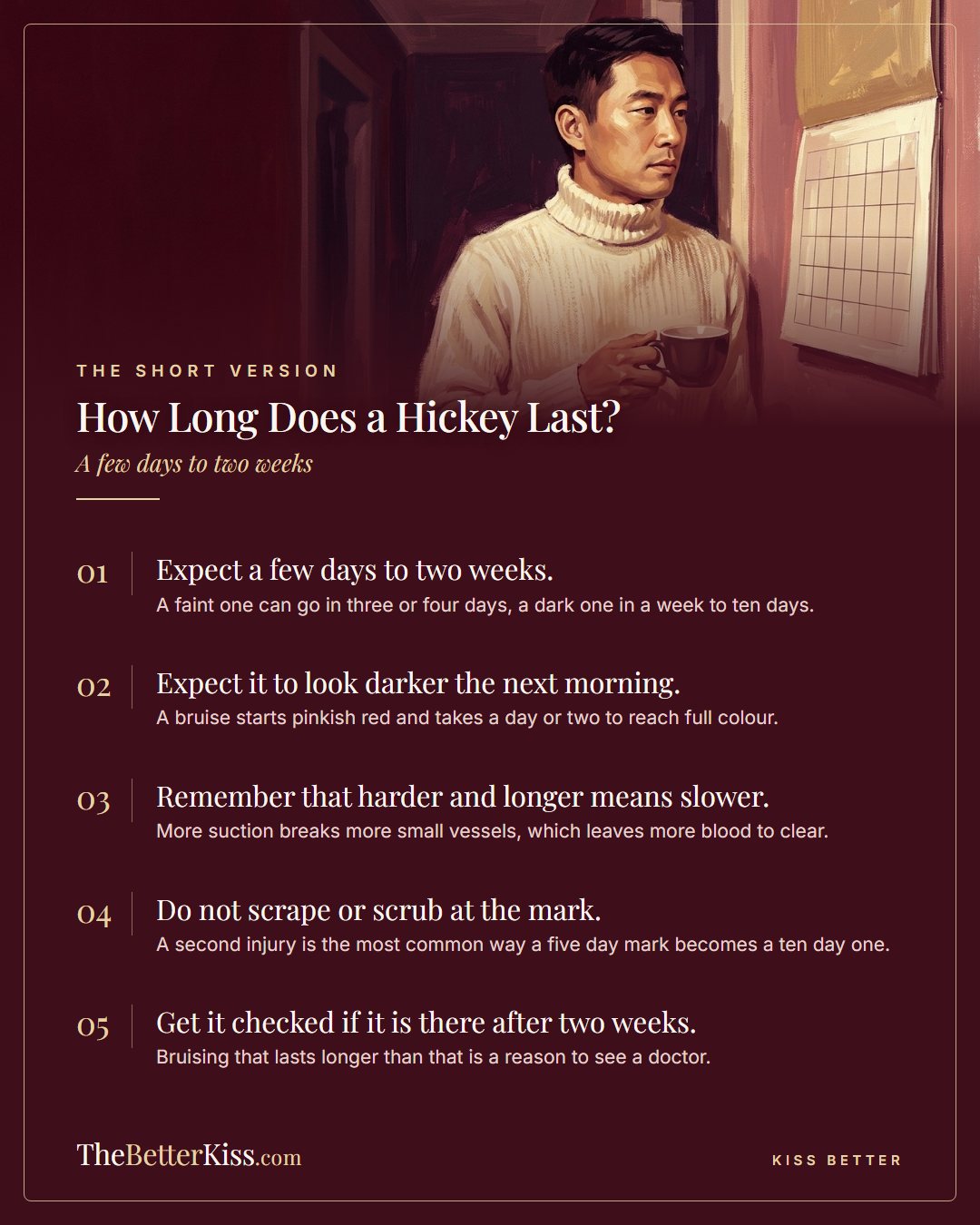
The range is wide because a hickey is a bruise, and bruises do not keep to a schedule. Here is what decides where yours falls.
How long do hickeys last?
Cleveland Clinic gives the figure most doctors use: most bruises last anywhere from three days to two weeks. Hickeys tend to sit at the shorter end, because they are a superficial form of bruising. The dermatologist quoted there compares one with a black eye: far less force went into your neck, so there is less blood to clear.
No one has run a study timing hickeys specifically. Everything known about how long they last comes from what is known about small bruises, plus a great deal of anxious personal experience.
How long does a hickey take to appear?
Usually minutes. A red or pink patch often shows almost straight away, though it can be faint enough to miss in low light. The darkening comes later. A bruise typically begins pinkish red and then changes to a bluish colour, so the mark you find in the mirror the next morning is often darker than the one you went to bed with. We could not find a study that measured this timing for hickeys, so treat "minutes to appear, a day or two to reach full colour" as typical experience, not a measured fact.
This is also why anyone giving one on purpose should stop early. The colour keeps developing after you do.
What does a hickey look like after 1, 3, 5 and 7 days?
Roughly this, for a medium-strength hickey on lighter skin:
- After 1 day: at its darkest or close to it. Red turning purple. Possibly a little tender.
- After 2 to 3 days: purple or bluish, edges starting to soften. This is peak visibility, and the worst day for photographs.
- After 4 to 5 days: fading in the middle, with green or yellow creeping in at the edges.
- After a week: yellow or light brown, noticeably smaller. A light hickey is gone by now.
- After 10 to 14 days: a faint shadow, then nothing.
Take the days loosely. Forensic researchers have spent decades trying to tell the age of a bruise from its colour and have largely concluded that you can't. One study of 369 photographs of bruises could only say that a bruise with yellow in it was more than 18 hours old. A later one, using instruments instead of eyes, found that even with age, sex, bruise size and skin colour factored in, yellowness predicted only about a third of a bruise's age. Your hickey has not read the chart. What each colour means is in our guide to hickey stages.
What makes a hickey last longer?
How hard and how long. More suction for longer breaks more small vessels, which leaves more blood to clear. A dark purple hickey outlasts a pink one for the same reason a bad bruise outlasts a mild one: more severe bruising can last a month or longer, though it would take an unusually determined partner to get a hickey into that category.
Your age. In the photograph study above, the yellow stage arrived significantly faster in people under 65. Ageing skin is also a recognised cause of bruising in the first place.
Medicines. If you take a blood thinner, including daily aspirin, you are likely to bruise more easily. Steroids are on the list as well. Expect a bigger mark from less pressure. Don't stop a prescribed medicine over a hickey.
Health and diet. Conditions that affect clotting, and a lack of vitamin C or vitamin K, make people more prone to bruising.
Interfering with it. Scraping at a hickey with a coin or toothbrush adds a second injury on top of the first. That is the most common way a five-day mark becomes a ten-day one. See what works and what doesn't.
Skin tone changes how visible each stage is more than how long healing takes. On darker skin a bruise tends to look purple, dark brown or black, and the fading stages are harder to see.
Where do hickeys last the longest?
There is no research comparing a hickey on the neck with one on the chest, shoulder or thigh, so anyone who gives you exact numbers by body part is guessing. What is true is that the neck is the place where a mark is hardest to cover and gets looked at most, which makes it feel longer.
Can you make a hickey go away faster?
Slightly, at best. Warm compresses are the standard advice and two creams have small trials behind them, but the honest summary is a day or so saved. The full evidence is in how to get rid of a hickey. For the days in between, hide it.
Can a hickey be permanent?
No. A bruise is blood that has leaked into the skin, and your body removes it. If a mark seems to be staying, it is usually one of two things. Either the skin was damaged by scraping or biting, which Cleveland Clinic's dermatologist warns can lead to additional discolouration and scar formation, or it was never a hickey to begin with.
When to see a doctor
A hickey that follows the pattern above needs nothing. Book an appointment if:
- The mark has not gone after two weeks. Bruising that lasts more than two weeks is on Cleveland Clinic's list of reasons to call.
- There is a firm lump under it, or painful swelling.
- It keeps coming back in the same place.
- You are getting bruises you can't explain, or large bruises from very little. MedlinePlus says to contact a doctor if you notice unexplained bruising that does not go away.
- You also have unusual bleeding, such as nosebleeds or blood in your urine.
Most of the time the explanation is ordinary. Occasionally easy bruising points to a clotting problem or a medicine that needs adjusting, and a blood test settles it.
Quick answers
How long does a hickey hurt for? Often not at all. A bruise can be tender to touch at first, and with a hickey that usually passes within a day or two. Pain that is getting worse is a reason to get it checked.
How long do dark purple hickeys last? Longer than red ones. Plan for a week to ten days, sometimes the full two weeks.
How long does a red hickey last? A mark that stays light red and never darkens is a mild one. A few days is typical.
Will my hickey be gone in one day? Almost certainly not. A very faint pink patch might be. A proper bruise will not.
How do you make a hickey last longer? You don't need to; they outstay their welcome as it is. If you both want a mark that shows, how to give a hickey covers doing it gently and with agreement.
Can a hickey cause long-term damage? Serious harm is very rare. The handful of reported cases are discussed in are hickeys dangerous?
Is a love bite the same thing, and does it last as long? Yes and yes. Same bruise, different name. The basics are in our main hickey guide.
This is general information, not medical advice. If you are worried about a symptom, speak to a doctor, dentist or pharmacist.
- Cleveland Clinic, "How To Get Rid of Your Hickey, Fast" (2024)
- Cleveland Clinic, "Bruises (Ecchymosis)" (2023)
- MedlinePlus, US National Library of Medicine, "Bruise" (2025)
- MedlinePlus, US National Library of Medicine, "Bleeding into the skin" (2025)
- Forensic Science International, "The ageing of bruises: a review and study of the colour changes with time" (1991)
- Forensic Science, Medicine and Pathology, "Use of reflectance spectrophotometry and colorimetry in a general linear model for the determination of the age of bruises" (2010)
If the nerves are the real problem
Knowing how isn't the same as being able to in the moment. The first module of our guided course is free: no card, no account, about ten minutes.
Start module one, free