Are Hickeys Dangerous? What the Medical Record Actually Says
Almost never. A hickey is a small, shallow bruise, and it heals by itself like any other bruise. The stroke stories you have seen are real but they rest on exactly two published medical case reports in the whole literature, both in women who had other risk factors, and no medically documented death. Here is the detail.
On this page
- Are hickeys dangerous?
- Can a hickey cause a stroke or a blood clot?
- Hickey death: what actually happened in Mexico?
- Where are hickeys dangerous?
- Why does my hickey hurt, and why is there a lump?
- Can hickeys cause cancer?
- Can you get HIV or herpes from a hickey?
- I get hickeys very easily. Is that an iron problem?
- Do hickeys scar?
- Are hickeys bad while pregnant?
- When to see a doctor
- Quick answers
Are hickeys dangerous?
For nearly everyone, no. Dermatologists describe a hickey as a bruise caused by trauma to the skin, such as by sucking or biting, and a superficial one. Blood from a few broken surface vessels sits in the skin, changes colour and is cleared away. Our main hickey guide covers the basics, and the stages article covers the colours.
The list of things that can go wrong is short: a very rare injury to the artery in the neck, a cold sore virus passed to the skin, a wound if teeth break the skin, and a scar if you attack the mark with a coin.
Can a hickey cause a stroke or a blood clot?
It has been reported twice. We searched PubMed and Europe PMC in November 2026 for every case report linking a love bite to a stroke, a clot or a torn neck artery, and found two.
New Zealand, 2010. Doctors at Middlemore Hospital in Auckland described a 44-year-old woman who developed weakness in her left arm several days after a love bite on the right of her neck. Scans found a clot partly blocking the internal carotid artery under the bruise. The artery was not torn; the authors thought its lining had been injured by compression. She was given blood-thinning medicine, the clot shrank within a week, her symptoms cleared in hospital, and she was well at one month. Two details rarely make the headlines: she had lupus, treated with steroids and methotrexate, and she smoked.
Greenland, 2014. A Danish journal reported a 35-year-old woman admitted to hospital in Nuuk with weakness down her right side, 12 hours after a kiss that left a mark on the left side of her neck. Ultrasound showed the left carotid artery almost blocked at the level of the mark, and a clot on the artery wall. This one ended less well. The clot had gone five days after treatment began, but three months on she still had moderate weakness and mild speech difficulty. She smoked, and her tests showed anaemia, a raised platelet count and raised homocysteine, which the authors say may have helped the clot form. Their English summary calls love bites “a rare cause of embolic stroke”, and they noted that the New Zealand report was the only earlier case they could find.
That is the whole published record: two cases, published in 2010 and 2014, one full recovery and one partial. No one counts hickeys, so nobody can give you a true rate, but set two reports against the number of love bites given in a single weekend. The New Zealand authors point out that even after car crashes and other blunt trauma, carotid artery injury is found in up to about 1% of victims.
A note on the words “blood clot”. The dark patch of a hickey is leaked blood in the skin, not a clot travelling anywhere. The two cases involved a clot inside the artery underneath.
Hickey death: what actually happened in Mexico?
In August 2016, news sites around the world reported that a 17-year-old in Mexico City had died of a stroke caused by a hickey. It needs saying plainly: this rests on news reports only. We could find no medical case report, no named doctor and no published finding on the cause of death. The fact-checking site Snopes traced the coverage and concluded that all reports seem to have originated from a single story on a Spanish-language site it describes as specialising in clickbait. A neurologist quoted in the same piece said a hickey stroke is unlikely but possible, and exceedingly rare.
So the accurate sentence is: there are two documented strokes, both survived, and one unverified report of a death.
Where are hickeys dangerous?
Both documented cases involved the same spot: the front and side of the neck, over the carotid artery. In the New Zealand report the bruise sat over the upper third of the muscle that runs down the side of the neck, and the Danish one was in the matching place on the other side. There are no such reports for the chest, arm, shoulder, back, stomach or thigh. If you want to be cautious, that is the whole precaution: keep hard suction away from the side of the throat below the jaw. How to give a hickey covers better places.
One other injury is indexed: a 1985 French report whose title describes a nerve injury from a love bite. We could confirm its citation but not read it.
Why does my hickey hurt, and why is there a lump?
Because it's a bruise, and bruises come with pain or tenderness when touched, and sometimes swelling or a raised bump. Tenderness for a day or two is normal. An ordinary over-the-counter pain reliever and leaving it alone are the sensible response; the removal guide covers what helps and what makes it worse.
Can hickeys cause cancer?
No. Cancer starts with changes to the genes that control how cells grow and divide, and a bruise does not do that. The nearest thing to a direct statement comes from Cancer Research UK, which says of the breast that physical trauma, injury or a blow does not cause cancer. We found no cancer body that lists bruising of any kind as a cause.
The link runs the other way round, and only occasionally. Bruising easily can sometimes be a symptom of a blood cancer such as leukaemia, because a low platelet count stops the body sealing small leaks. That is about marks appearing without a cause. A hickey has one, and you were there.
Can you get HIV or herpes from a hickey?
HIV: no. The US government's HIV service states that HIV is not transmitted through saliva and can't be passed through healthy, unbroken skin. A hickey is saliva on unbroken skin. Even for an actual bite, the same page says there is no risk if the skin is not broken. The NHS puts it more briefly: you cannot get HIV from kissing.
Herpes: possible, if there's a cold sore. The World Health Organization says HSV-1, the cold sore virus, is mainly transmitted via contact with the virus in sores, saliva or skin around the mouth, with the greatest risk when sores are active. The NHS warns that cold sores can easily spread to other people and other parts of your body, and health departments that deal with herpes among wrestlers note that the infection can show up anywhere on the skin. A 1987 letter in the New England Journal of Medicine is even titled “A herpetic hickey”, though we could not get past its title. The rule is simple: no hickeys, and no kissing, while a cold sore is active. More in cold sores and kissing.
Broken skin. If teeth break the skin it is a bite, and the NHS advice for human bites applies: clean the wound with soap and warm water and get medical help if it looks infected.
I get hickeys very easily. Is that an iron problem?
Probably not iron. The NHS list of symptoms of iron deficiency anaemia runs through tiredness, breathlessness, palpitations and pale skin, and bruising is not on it. The causes of easy bruising that medical sources do list are these: medicines that thin the blood or stop clotting, such as aspirin; regular anti-inflammatory painkillers such as ibuprofen; a low platelet count; a bleeding disorder; a vitamin C or vitamin K deficiency; and relatives who bruise easily.
What matters is the pattern. One hickey from one evening is explained. Frequent, large or unexplained bruises are worth a blood test.
Do hickeys scar?
Not if you leave them alone. The mark is a stain in the second layer of the skin, and the surface is intact. The scarring risk comes from the home remedies: a Cleveland Clinic dermatologist warns that scrubbing or scraping a hickey can leave scratches, bleeding, additional discoloration and scar formation. Cover it instead; hiding a hickey is easier than repairing one.
Are hickeys bad while pregnant?
We could not find any medical source that names hickeys as a risk in pregnancy, so treat this as reasoning, not evidence: a bruise on your skin stays in your skin. The neck caution above applies to everyone. If you are bruising far more easily than you used to, mention it at your next appointment. See also kissing during pregnancy.
When to see a doctor
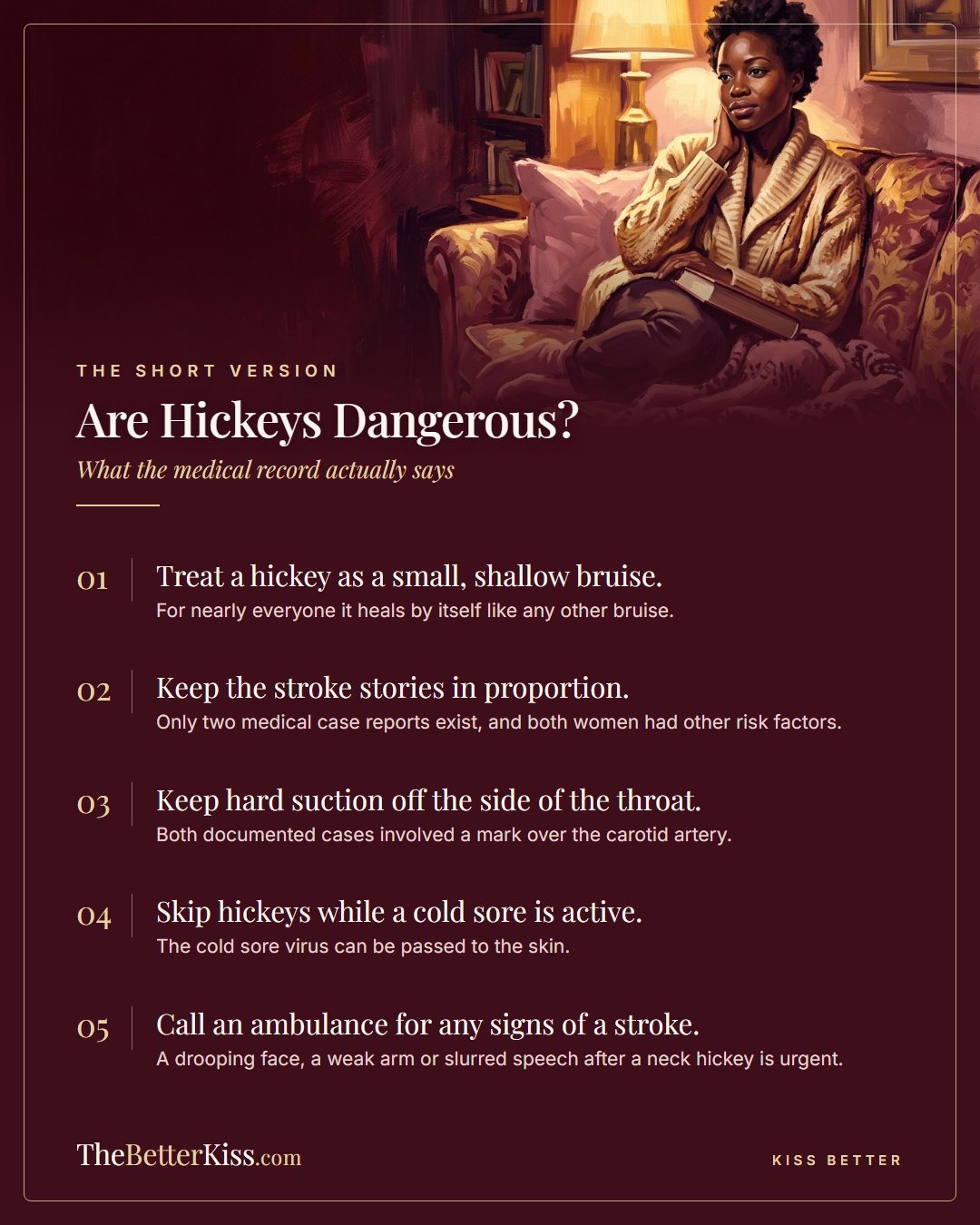
Call an ambulance if, in the hours or days after a hickey on the neck, you get the signs of a stroke. The NHS lists one side of the face drooping, weakness or numbness in one arm, and slurred or confused speech. An injured neck artery can also announce itself with pain in the eye, face, head or neck, or a sagging eyelid. Very unlikely, and not something to sleep on.
Book an ordinary appointment for the things on the Cleveland Clinic list: a bruise that lasts more than two weeks, a lump in it, painful swelling, frequent large bruises or bruising you can't explain. Also for blisters on or near the mark, or broken skin that turns red, hot or weepy. How long a hickey lasts has the normal timeline.
Quick answers
Do hickeys hurt? A little, sometimes. They are tender to touch for a day or two, like any bruise, and many don't hurt at all.
Can a hickey bleed? Not through unbroken skin. If it is bleeding, teeth or scraping have broken the surface, so treat it as a small wound.
Can hickeys cause headaches, dizziness or a sore throat? A bruise in the skin doesn't. A sudden severe headache, dizziness, or face, arm or speech changes are on the NHS list of stroke symptoms, so get urgent help.
Are hickeys on the chest or arm dangerous? There are no reports of serious injury from either. The only site in the case reports is the neck over the carotid artery.
Is giving a hickey dangerous for the giver? No, unless the other person has an infection on that patch of skin. And ask first: it's their neck and their week.
This is general information, not medical advice. If you are worried about a symptom, speak to a doctor, dentist or pharmacist.
- New Zealand Medical Journal, "Love bites: an unusual cause of blunt internal carotid artery injury" (2010)
- Ugeskrift for Laeger, "Kys på halsen endte i iskæmisk apopleksi" (2014, full text in Danish)
- PubMed, "Love bite on the neck resulted in an embolic stroke", English abstract (2014)
- Snopes, "Teen Dies from Hickey in Mexico?" (2016)
- PubMed record, Presse Médicale, "An unusual cause of spinal nerve injury. A love bite" (1985, citation only)
- PubMed record, New England Journal of Medicine, "A herpetic hickey" (1987, citation only)
- Cleveland Clinic, "How To Get Rid of Your Hickey, Fast" (2024)
- Cleveland Clinic, "Bruises (Ecchymosis)" (2023)
- WebMD, "Hickeys: What You Need to Know" (medically reviewed 2025)
- Cleveland Clinic, "Carotid Artery Dissection"
- NHS, "Symptoms of a stroke"
- National Cancer Institute, "What Is Cancer?"
- Cancer Research UK, "Cancer myths"
- MD Anderson Cancer Center, "Ecchymosis: 7 things to know about bruising and cancer" (2026)
- HIV.gov, "How Is HIV Transmitted?"
- NHS, "HIV and AIDS: causes"
- World Health Organization, "Herpes simplex virus" fact sheet
- NHS, "Cold sores" (2024)
- Wisconsin Department of Health Services, "Herpes Gladiatorum"
- NHS, "Animal and human bites"
- NHS, "Iron deficiency anaemia"
If the nerves are the real problem
Knowing how isn't the same as being able to in the moment. The first module of our guided course is free: no card, no account, about ten minutes.
Start module one, free