What Does a Hickey Mean?
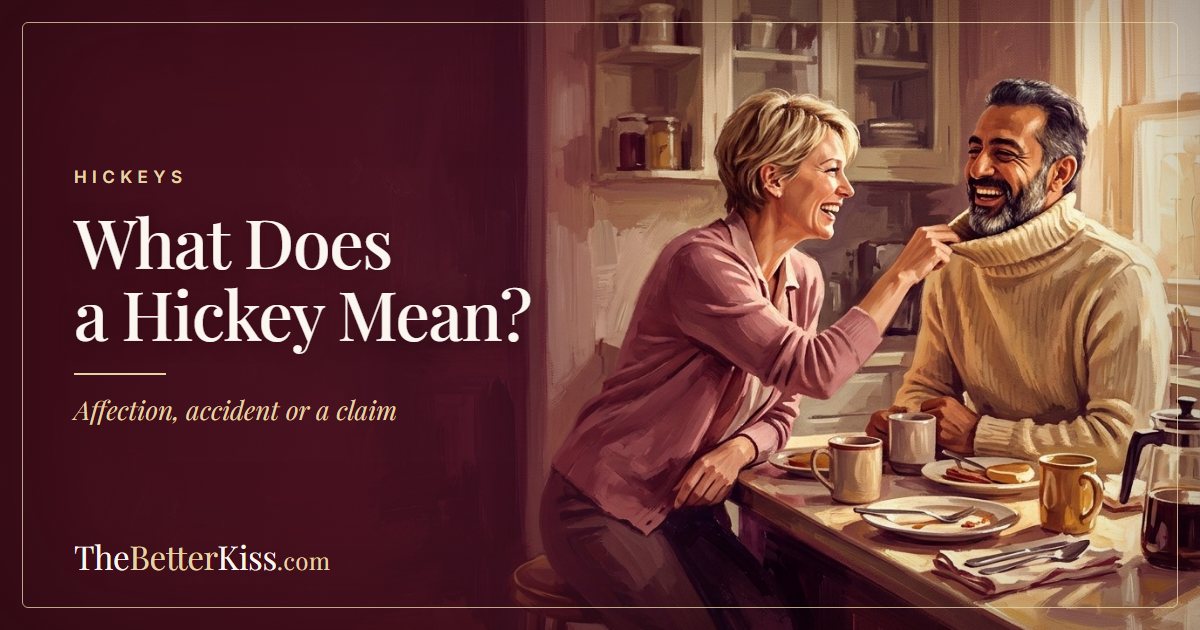
A hickey means that someone kissed a patch of your skin hard enough, for long enough, to bruise it. Everything beyond that depends on who gave it, whether you agreed to it, and where it is. It can be affection, a private joke, an accident or a claim, and the same mark can be any of the four.
On this page
- What does a hickey mean, literally?
- Why do people give hickeys?
- What does it mean when someone gives you a hickey?
- Are hickeys possessive or territorial?
- Hickeys without consent
- Are hickeys trashy, immature or normal?
- Hickeys at work
- What does a hickey mean in a relationship, and when it's casual?
- Does a hickey mean cheating?
- What does a hickey on the neck, chest or thigh mean?
- Quick answers
One thing to say up front. We looked for survey or psychology research on why people give hickeys and what others read into them, and found almost none. So most of what follows is plain observation, and we say so where it is. The one academic source we do quote is a legal one.
What does a hickey mean, literally?
A hickey, or love bite in British English, is a dark red or purple mark on the skin caused by intense suction. It is a bruise. It does not have to involve biting, despite the name. In messages and chat, “hickey” means exactly this and nothing more coded. Our main hickey guide covers the physical side.
Why do people give hickeys?
From watching how people talk about them, there seem to be four reasons, and they overlap.
They got carried away. This is the commonest. Neck kissing with a little too much suction, held a little too long, and nobody noticed until the mirror the next morning. It means enthusiasm and not much else.
It felt good to both of you. Some people like the sensation of receiving one, and some like giving one. Then the mark is a by-product.
They wanted to leave a sign. A visible reminder of the evening, for you, for them, or for other people. This is where the word “possessive” comes in, and it gets its own section below.
You asked. Plenty of hickeys are requested. Then it means what you wanted it to mean.
What does it mean when someone gives you a hickey?
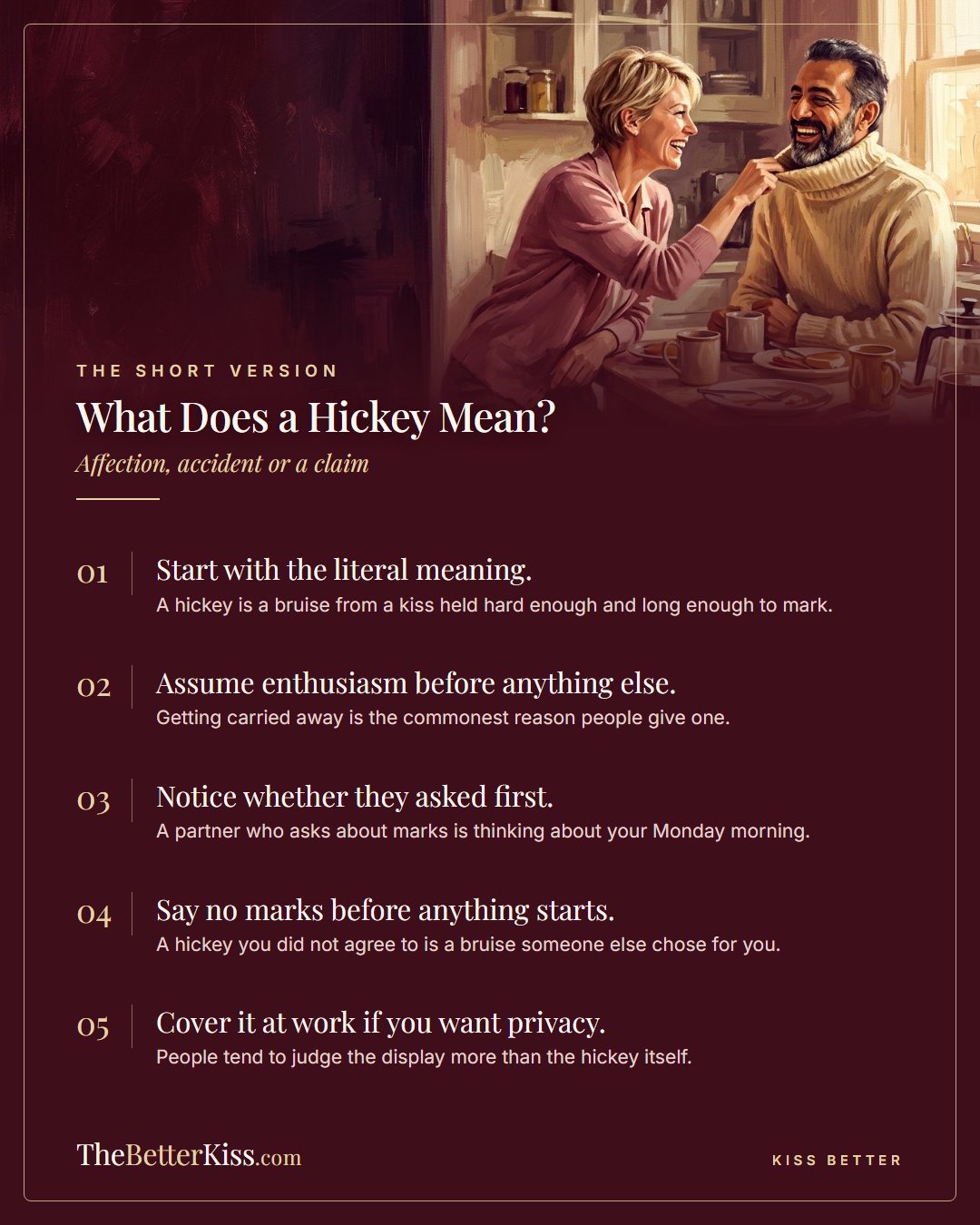
Whether it comes from a man or a woman makes no difference that we can see; the reasons above are the same list. What matters more is whether they asked. A partner who asks “can I leave a mark?” and listens to the answer is telling you they think about your Monday morning. A partner who leaves one on your throat after you said no marks is telling you something as well.
Is a love bite a sign of love? It is a sign of desire and of an unguarded moment. Love shows up in less photogenic ways, such as asking first.
Are hickeys possessive or territorial?
They can be. A mark placed high on the neck, where it cannot be covered, does a job that a mark on the shoulder does not: it tells other people. If that is why it was put there, “marking territory” is a fair description, and how you feel about it is the test. Some couples enjoy the idea and agree to it.
It stops being playful when it is done to you instead of with you. Researchers who study violence in relationships have written about this directly. A University of Sheffield law chapter quotes their finding that a love bite alone does not signify a violent relationship, and that consent is usually assumed and pleasure implied, but that in a violent relationship love bites may be used as a means of control and possession. The mark looks the same in both cases, which is the point. A partner who marks you to warn others off, to check on you or to punish you is not being romantic.
Hickeys without consent
A hickey you did not agree to is a bruise someone else decided you would carry for a week, in a place they chose. You are entitled to be annoyed, and “no marks” is a complete sentence you can say before anything starts. If you gave one without asking, apologise without excuses and ask next time. If a partner keeps doing it after you have said no, the hickey is not the real problem. How to give a hickey starts with the asking for this reason.
Are hickeys trashy, immature or normal?
Normal, in the sense that they are common and harmless. Whether they look immature is a social judgment, not a fact, and it varies with age, workplace and family. What people tend to judge is not the hickey but the display: an uncovered mark at a client meeting reads as either carelessness or showing off. The same mark under a collar is nobody's business.
There is no need to be ashamed of one. Cleveland Clinic's dermatology advice makes the same point, saying you don't have to cover up your hickey if you feel safe leaving it uncovered. If you would prefer to keep it private, hiding a hickey takes five minutes.
Hickeys at work
Cover it. This is observation, not law: we found no legal source to cite, and rules on dress and appearance differ by country and employer. In practice a visible love bite is unlikely to cost anyone a job by itself, but in customer-facing work it invites comment you do not need. A collar, a scarf or concealer solves it, and it will be gone in days to a couple of weeks.
What does a hickey mean in a relationship, and when it's casual?
Between long-term partners a hickey is usually just an accident of a good evening, and the only negotiation is where. With someone new or casual it carries more weight, because a visible mark makes a private thing public before either of you has decided what it is. If you are seeing other people, or simply do not want questions, say “no marks” early.
Does a hickey mean cheating?
Not by itself. A fresh mark that your partner did not give is a fair reason for a question, but be sure it is a hickey before you ask it. Bruises from knocks, straps and sport turn up in the same places, and people who bruise easily get marks they cannot account for. Ask a direct question and listen to the answer.
What does a hickey on the neck, chest or thigh mean?
Neck. The default, and the public one. Often an accident of neck kissing; if deliberate, it was meant to be seen.
Chest, shoulder, collarbone. Usually a considerate choice or an agreed one. It is for the two of you.
Inner thigh. Private by definition. It says nothing to anyone else, which is the idea.
Face, cheek or forehead. Almost always a joke or a mistake.
Quick answers
What does a dark, red, green or yellow hickey mean? Only its age and depth. Bruises start red, go dark, then turn green and yellow as they heal. See hickey stages.
Why is it called a love bite? Because of how it is given, not because teeth are needed. Suction makes the mark.
What does flaunting a hickey mean? Usually pride or mischief. Sometimes the person simply forgot it was there.
Do hickeys have a spiritual or dream meaning? None that rests on any evidence. It is a bruise.
Are hickeys dangerous? Almost never. The medical record is short and reassuring.
- WebMD, "Hickeys: What You Need to Know" (medically reviewed 2025)
- Spalding A, University of Sheffield, "The legality of lovebites", in 'Rough Sex' and the Criminal Law (Emerald, 2022), accepted manuscript
- Cleveland Clinic, "How To Get Rid of Your Hickey, Fast" (2024)
- Cleveland Clinic, "Bruises (Ecchymosis)" (2023)
If the nerves are the real problem
Knowing how isn't the same as being able to in the moment. The first module of our guided course is free: no card, no account, about ten minutes.
Start module one, free